
Best Dust Collectors for Small Shops: Spec Comparison
Quick answer: which collector fits which shop
- Best for most small shops: Shop Fox W1826 1 HP wall unit. Two publications tested it hands-on: Fine Woodworking named it best value after a chip-collection test,[13] and Family Handyman's tester reported it caught more than 99% of table-saw dust.[12] It draws just 7 A at 120V.[5]
- Finest bag filtration on a wall unit: Powertec DC5371, 1-micron bag. Family Handyman picked it as its best wall mount.[12]
- Ducted collection with a 240V circuit: Grizzly G0548ZP 2 HP canister, 1,700 CFM rated, 10 in. maximum static pressure, 1-micron canister.[10] Family Handyman tested it and judged it best for bigger shops.[12]
- A rolling 1 HP unit you wheel to each machine: Shop Fox W1727, 800 CFM rated, on a standard 120V outlet.[7] Its maker says it is meant for one machine at a time.[8]
- Budget pick and the lightest here: WEN DC3401, 17 lb, 5.7 A at 120V.[2] Popular Mechanics chose it as its budget option.[14] WEN doesn't publish pressure data, so keep the hose short.
Not sure how much airflow you need? Run your layout through the dust collector CFM calculator first. We check each model against that method where data exists.
How we chose and compared
- Scope: dust collectors that make sense in a one- or two-car garage or basement shop: 120V-capable units from a 17 lb portable up to 1 HP, plus one 240V canister unit for shops ready to run ductwork. We favored models that are current on their maker's site and that at least one established publication has reviewed or ranked.
- Specs come from each manufacturer's own product page, data sheet, or owner's manual.
- Review findings are summarized in our own words from Family Handyman, Fine Woodworking, Popular Mechanics, and Bob Vila, with links. We note which of those outlets ran their own tests and which made research-based picks. We don't reproduce anyone's scores, and we don't use retailer star ratings or shopper comments.
- The yardstick is our sizing guide, built on Grizzly's published method: about 400 CFM for a 4 in. machine port, and a collector that still delivers that airflow at the static pressure of your duct run.[9]
Spec table: all five side by side
| Spec | WEN DC3401[1][2] | Powertec DC5371[3] | Shop Fox W1826[4][5] | Shop Fox W1727[6][7] | Grizzly G0548ZP[10][11] |
|---|---|---|---|---|---|
| Type | Portable bag, rolls or wall-mounts | Wall-mount bag | Wall-mount felt bag | Rolling single-stage bag | Single-stage canister |
| Motor | No HP figure; 5.7 A brushed, 4,500 RPM | 1 HP, 3,450 RPM | 1 HP TEFC induction | 1 HP TEFC induction | 2 HP TEFC induction |
| Voltage / amps | 120V / 5.7 A | 120V / 12 A or 240V / 6 A | 120V / 7 A or 240V / 3.5 A | 120V / 9 A or 240V / 4.5 A | 240V only / 9 A |
| Circuit / plug (per maker) | Standard 120V outlet | 120V or 240V | 15 A; 5-15 plug at 120V | 15 A; 5-15 plug at 120V | 15 A at 240V; 6-15 plug |
| Rated airflow | 660 CFM | 560 CFM | 537 CFM | 800 CFM | 1,700 CFM |
| Maximum static pressure | Not published | 7.2 in. (at 0 CFM) | 7.2 in. | 5.67 in. (at 0 CFM) | 10 in. |
| Filtration (as rated) | 5-micron bag | 1-micron bag | 2.5-micron felt bag | 2.5-micron upper bag | 1-micron canister |
| Inlet | 4 in. | 4 in. | 4 in. | 4 in. | 6 in. with 3 × 4 in. adapter |
| Impeller | 6 in. nylon | 10 in. radial | 10 in. radial fin | 9 in. steel radial fin | 12-3/4 in. cast aluminum |
| Collection capacity | 12 gal bag | Bag size only (14-1/2 × 25-1/2 in.) | 2 cu. ft. bag (1.5 cu. ft. max material) | 2.1 cu. ft. | 4.5 cu. ft. |
| Weight | 17 lb | 35.5 lb | 51 lb | 55 lb | 145 lb |
| Noise (as published) | 71 dBA at 22 ft | Not published | < 85 dB | Not published | Not published |
| Warranty (per maker) | 2 years (brushes excluded) | 1 year; 30-day satisfaction guarantee | 2 years | 2 years (data sheet) | 1 year |
Hose, duct, and static pressure
Our sizing guide works out two numbers for your worst duct run: the airflow your largest machine needs (about 400 CFM for a 4 in. port) and the static pressure of the run to it.[9] Checking a collector against those numbers takes the maker's airflow curve, and none of the current collectors here publishes one. For these five, compare maximum static pressure instead: a higher number holds airflow better on long hoses and duct runs.
- Short hose to one machine: all five are built for it. The two wall units were reviewed this way, on about 6 ft of 4 in. hose.[13]
- Ductwork to several machines: the G0548ZP is the one to plan around (10 in. maximum static pressure, 1,700 CFM rated).[10] Ask Grizzly for airflow data before you finalize the layout.
- Don't run ductwork off the W1727; it's built for one machine on a short hose.[8]
What the specs reveal (our analysis)
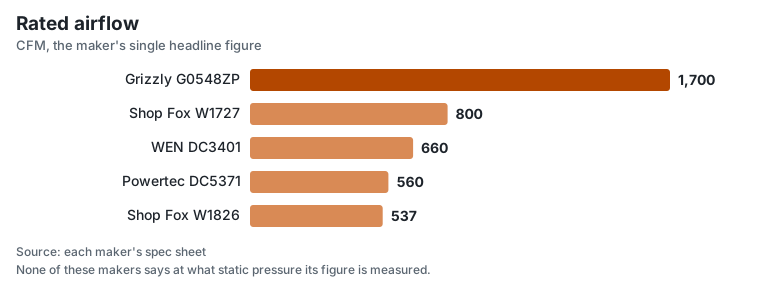
Each maker publishes one airflow number, and it's not the one you'll get
"800 CFM" or "660 CFM" on a box is measured somewhere near zero resistance, and none of these five makers says where. Fine Woodworking's reviewer warned that maker airflow ratings are sometimes taken from the blower alone, without the filter fitted, which flatters the number.[13] Real airflow through your hose will be lower; the sizing guide shows by how much on one published curve.
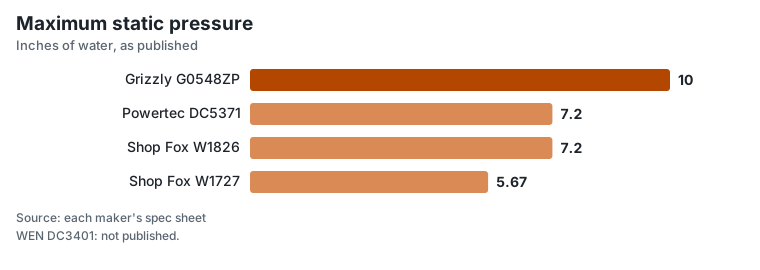
Maximum static pressure is the one secondary number worth comparing
Without curves, maximum static pressure is the best hint of how well a collector copes with hose and duct. The G0548ZP lists 10 in., the two wall units 7.2 in., and the W1727 5.67 in.[3][5][7][10] That flips the headline ranking. The W1727 has the highest rated CFM of the four 120V-friendly bag units (800) but the lowest pressure ceiling, so it's likely to lose airflow faster as hose length grows. The W1826 and Powertec are rated lower (537 and 560 CFM) but share a 7.2 in. ceiling. WEN doesn't publish pressure data, and its 6 in. impeller is the smallest here, so keep its hose short.[2]
"120V" doesn't always mean "plugs into any garage outlet"
- WEN DC3401, 5.7 A: the lightest electrical load here.[2]
- Shop Fox W1826, 7 A; W1727, 9 A: both on a 15 A circuit with a standard 5-15 plug, and both can be rewired for 240V (3.5 A and 4.5 A).[5][7]
- Powertec DC5371, 12 A at 120V: runs on a standard circuit, but 12 A plus a 15 A table saw is 27 A, far more than a 15 A or 20 A circuit can carry. Plan a separate circuit for the saw, or use the 240V option (6 A).[3]
- Grizzly G0548ZP: 240V only, 9 A, 6-15 plug.[10] Family Handyman listed the 240V requirement as its only con.[12]
Have an electrician confirm what your panel and wiring can support before you buy any of the higher-draw units.
Filtration: the micron number decides what you breathe
OSHA links airborne wood dust to allergic and non-allergic respiratory symptoms and to cancer.[16] The ratings here run from 5 microns (WEN bag) through 2.5 (both Shop Fox bags) and 1 (Powertec bag, G0548ZP canister).[2][3][5][7][10] Family Handyman notes that particles under 10 microns are the most harmful to lungs and recommends bags rated 5 microns or finer.[12] A micron number on its own doesn't say how much of that size a filter catches, so Oneida Air Systems suggests asking each maker for the filter's efficiency rating and whether a third party tested it.[17] Shop Fox's W1727 manual says plainly that dust collectors don't remove all of the finest, most harmful dust, and tells owners to wear a NIOSH-approved respirator.[8]
Why a cyclone or canister helps beyond the micron number: on a single bag like the W1826's, the same felt bag is both filter and chip bin,[13] so it loads up as it fills. A cyclone separator drops chips before they reach the filter, which Oneida says keeps airflow up.[17] Grizzly's sizing method budgets 1 in. of static pressure for a used filter for the same reason.[9]
Brushed vs induction motors
The WEN uses a brushed motor; WEN says to inspect the carbon brushes every 60 hours of running and doesn't cover brushes under its 2-year warranty.[2] The Shop Fox units and the G0548ZP list TEFC (totally enclosed, fan-cooled) induction motors.[5][7][10] If you mill rough lumber for hours at a time, that maintenance difference adds up.
Model-by-model: specs plus what reviewers found
1. Shop Fox W1826: best for most small shops
Specs: 1 HP TEFC induction, 120V/240V (7 A / 3.5 A), 537 CFM, 7.2 in. maximum static pressure, 10 in. impeller, 4 in. inlet, 2.5-micron felt bag (2 cu. ft.), 44 in. tall with the bag inflated, 51 lb, under 85 dB, 2-year warranty.[4][5]
What reviewers found: Fine Woodworking tested six wall-mounted collectors by running 100 jointer passes on thick fir through about 6 ft of 4 in. hose. All five smaller units, the W1826 included, collected more than 95% of the chips, and the reviewer judged the differences minor as long as hoses stay under about 6 ft. It named the W1826 best value. The felt bag keeps cost and weight down, but chips are slow to shake out through the short bottom zipper, so the reviewer suggests emptying it outdoors.[13] Family Handyman's tester reported it collected more than 99% of table-saw dust, handled about 100 jointer passes before a bag change, and was quieter than most shop vacs. The downside was a fibrous bag exterior that dust clings to.[12] Popular Mechanics listed it as the lightest pick in its roundup.[14]
Hose and duct: best on short hoses to one machine, which is how both reviewers used it; 7.2 in. maximum static pressure.
Why it's our top pick: it is the only collector here that two publications tested hands-on and both rated well, on the job most small shops have: one table saw or jointer on a short hose. Its TEFC induction motor needs no brush changes and draws the least current of the induction-motor units here (7 A at 120V), so it shares a circuit more easily than the 12 A Powertec. It hangs on the wall, so it takes no floor space. The trade-offs: a felt bag that is slow to empty, and a 537 CFM rating meant for short hoses, not ductwork.
Fits: a dedicated collector beside a table saw or jointer, or a small shop's only collector if machines can sit close to it.

Dust Collection
Shop Fox W1826
Best for: A dedicated wall unit beside a table saw or jointer, or a small shop's only collector.
- Rated airflow537 CFM
- Motor1 HP TEFC; 120V / 7 A
- Max static pressure7.2 in.
- Filtration2.5-micron felt bag
- Weight51 lb
2. Powertec DC5371: finest-rated bag of the wall units
Specs: 1 HP, 120V/240V (12 A / 6 A), 3,450 RPM, 560 CFM, 7.2 in. maximum static pressure at 0 CFM, 10 in. radial impeller, 4 in. inlet, 1-micron bag with a clear window and bottom zipper, 35.5 lb.[3]
What reviewers found: Family Handyman named it best wall mount. The tester liked the small footprint, the 1-micron bag with a viewing window, and the snap-band ring for bag changes, and moved the shop vac out of the way once it was up. The cons were noise (loud but not high-pitched) and setup: on a stud wall you need a mounting board across the studs (not included), the band clamp has sharp edges, and the first few bag fittings go easier with a helper.[12] Bob Vila's research-based list also chose it as the best wall-mounted pick, crediting the dual-voltage motor and safety switch, and noting the 4 in. hose needs an adapter for small 2-1/2 in. tool ports.[15]
Hose and duct: same 7.2 in. ceiling as the W1826. Mind the 12 A draw on 120V.
Fits: one or two machines on short hoses where finer bag filtration matters to you, ideally on its own circuit or at 240V.

Dust Collection
Powertec DC5371
Best for: A wall-mounted collector beside one or two machines, with finer 1-micron bag filtration.
- Rated airflow560 CFM
- Motor1 HP; 120V / 12 A or 240V / 6 A
- Max static pressure7.2 in.
- Filtration1-micron bag
- Weight35.5 lb
3. Grizzly G0548ZP: 240V canister for shops ready to run ductwork
Specs: 2 HP TEFC capacitor-start induction, 240V only, 9 A, 6-15 plug on a 15 A circuit; 1,700 CFM; 10 in. maximum static pressure; 12-3/4 in. cast-aluminum impeller; 6 in. inlet with a 3 × 4 in. adapter; 1-micron spun-bond polyester canister; 4.5 cu. ft. collection; 145 lb; 1-year warranty.[10][11]
What reviewers found: Family Handyman's tester judged it best suited to bigger or professional shops. They praised the adapter for running three 4 in. lines at once, the built-in brush that cleans the canister from the outside, easy assembly, and the clear lower bags. The listed con was the 240V circuit. The review also advises smooth pipe and gentle bends over flex hose and sharp 90s to limit static-pressure loss.[12]
Hose and duct: the highest rated airflow and maximum static pressure (10 in.) here, so it is the one of these five to plan a 6 in. main around. Grizzly publishes no airflow curve for it, so ask for test data before you finalize ductwork.
Fits: a two-car garage shop with a 240V circuit and a planned duct system.

Dust Collection
Grizzly G0548ZP
Best for: A two-car garage shop with a 240V circuit and a planned duct system.
- Rated airflow1,700 CFM
- Motor2 HP TEFC; 240V only / 9 A
- Max static pressure10 in.
- Filtration1-micron canister
- Weight145 lb
4. Shop Fox W1727: highest rated CFM of the 1 HP units, lowest pressure ceiling
Specs: 1 HP TEFC capacitor-start induction, 120V/240V (9 A / 4.5 A), 800 CFM, 5.67 in. maximum static pressure at 0 CFM, 4 in. inlet, 2.5-micron upper bag over a clear plastic lower bag (2.1 cu. ft.), 55 lb, single-stage.[6][7] The manual describes it as built to collect from one machine at a time, not to power a whole-shop duct system, and says system CFM drops sharply with the wrong duct size, extra length, or too many bends.[8]
What reviewers found: Bob Vila's research-based list named it best overall, citing the keyed safety switch, high rated airflow, and handle and wheels. Its one con was the adapter needed for 2-1/2 in. hoses.[15] Popular Mechanics' editor picked it as the best mid-size option for its four casters, steering handle, and clear bag that shows when to empty it. They flagged that one intake isn't ideal for a busy shop.[14] Neither outlet describes running its own airflow test on it.
Hose and duct: don't run ductwork off the W1727; it's built for one machine on a short hose.
Fits: a shop that wheels one collector from machine to machine with a short hose.

Dust Collection
Shop Fox W1727
Best for: A shop that wheels one collector from machine to machine on a short hose.
- Rated airflow800 CFM
- Motor1 HP TEFC; 120V / 9 A
- Max static pressure5.67 in.
- Filtration2.5-micron upper bag
- Weight55 lb
5. WEN DC3401: lightest and simplest, for one tool on a short hose
Specs: 120V, 5.7 A brushed motor at 4,500 RPM, 6 in. nylon impeller, 660 CFM, 4 in. inlet, 12-gal 5-micron zippered bag, 71 dBA at 22 ft, 17 lb, lockable casters, optional wall mount, 2-year warranty (brushes excluded). No horsepower or static-pressure figure is published.[1][2]
What reviewers found: Popular Mechanics' editor picked it as the best budget option. They liked the carry handle, lockable casters, the option to mount it on the wall, and the 2-year warranty, but noted the bag isn't transparent.[14] (Popular Mechanics' list is an editor's selection, updated May 2024.)
Hose and duct: WEN doesn't publish pressure data, so keep the hose short.
Fits: a starter shop with one 4 in. port tool at a time, a short hose, and light use. Upgrade to a finer bag or move to a better-filtered unit if you sand or mill a lot.

Dust Collection
WEN DC3401
Best for: A starter shop with one 4 in. port tool at a time and a short hose.
- Rated airflow660 CFM
- Motor120V / 5.7 A
- Filtration5-micron bag
- Inlet / capacity4 in. / 12 gal bag
- Weight17 lb
Which shop each one fits
| Your shop | Best match here | Why (from the data above) | Watch out for |
|---|---|---|---|
| Corner of a one-car garage, one 4 in. tool at a time, light use | WEN DC3401 | Lowest draw (5.7 A), lightest (17 lb), rolls or hangs | No pressure data; 5-micron bag; brush maintenance |
| Table saw or jointer that needs its own collector, little floor space | Shop Fox W1826 or Powertec DC5371 | 7.2 in. ceiling; both reviewed well on short hoses; wall-mounted | Keep hoses near 6 ft; Powertec's 12 A at 120V |
| Several machines, one collector you wheel between them | Shop Fox W1727 | Highest rated CFM of the 1 HP units; casters and handle | Lowest pressure ceiling (5.67 in.); not for ductwork |
| Ducted system, 240V available, bigger chip load | Grizzly G0548ZP | 10 in. ceiling, 1,700 CFM rated, 1-micron canister, 3-way adapter | 240V only; ask Grizzly for airflow data |
| 14–20 in. planer with a 6 in. port | Grizzly G0548ZP at most | Grizzly's sizing chart puts that planer at about 850 CFM[9] | Look at 2 HP+ collectors and ask the maker for an airflow chart |
Buying guide for a small-shop dust collector
- Size first. Use the CFM calculator on your longest or most-bent run. Write down the CFM target and the static pressure.
- Ask for the fan curve. If the maker publishes one, check the CFM at your static pressure. If not, ask. A single "max CFM" figure can't be checked against your shop.
- Compare maximum static pressure when no curve exists. A higher ceiling leaves more room for hose and duct losses.
- Decide hose or ductwork. 1 HP units do their best work on short hoses to one machine. Ductwork to several machines calls for more pressure and published data.
- Check your circuit. Add the collector's amps to any tool on the same circuit, and confirm whether the airflow rating assumes a 30 A or 240V supply.
- Pick filtration on purpose. Finer ratings catch more of the dust that matters to your lungs. Canisters and cyclones keep the filter from choking as the bin fills.
- Plan the space. Wall units need solid mounting (masonry or a board across studs). Cyclones need floor space and headroom.
- Wear a respirator for sanding and fine-dust work regardless of the collector.
Frequently asked questions
What is the best dust collector for a small shop?
For most small shops, the Shop Fox W1826: a 1 HP wall unit that Fine Woodworking and Family Handyman both tested and rated well on short hoses. If you have a 240V circuit and plan ductwork to several machines, look at the Grizzly G0548ZP 2 HP canister.
Is a 1 HP dust collector enough for a table saw?
For a short hose straight to the saw, usually yes. Fine Woodworking found 3/4 to 1 HP wall units collected more than 95% of jointer chips through about 6 ft of hose. For long duct runs, step up to a larger collector and ask the maker for an airflow chart.
Why is a collector rated at 800 CFM not always better than one rated at 560?
Rated CFM is measured near zero resistance. In a real hose or duct, what matters is airflow at your static pressure. The 800 CFM Shop Fox W1727 lists a 5.67 in. maximum static pressure, while the 560 CFM Powertec lists 7.2 in., so the Powertec may hold up better as resistance rises.
Do I need a 240V dust collector?
Not for most small-shop 1 HP units, which run on a standard 15 A 120V circuit. Larger units often need 240V, like the Grizzly G0548ZP. Check the manual before you buy.
What micron filter should a dust collector have?
Finer is better for your lungs. Family Handyman recommends 5 microns or finer. In this comparison, the Powertec bag and the Grizzly G0548ZP canister are rated at 1 micron. Ask the maker how the rating was measured, and wear a respirator for sanding either way.
Sources
- WEN Products, DC3401 5.7-Amp 660 CFM Rolling Dust Collector product page. wenproducts.com/products/wen-dc3401-…
- WEN Products, DC3401 instruction manual (specifications, brush maintenance, warranty). cdn.shopify.com/…/DC3401.manual.20210802.pdf
- Powertec, DC5371 wall-mount dust collector manual (product specifications, electrical). powertecproducts.com/content/DC5371.pdf
- Shop Fox (Grizzly Industrial), W1826 1 HP Wall Dust Collector product page. grizzly.com/products/shop-fox-1-hp-wall-dust-collector/w1826
- Shop Fox, Model W1826 machine specifications data sheet. cdn0.grizzly.com/specsheets/w1826_ds.pdf
- Shop Fox (Grizzly Industrial), W1727 1 HP Dust Collector product page. grizzly.com/products/shop-fox-1-hp-dust-collector/w1727
- Shop Fox, Model W1727 machine specifications data sheet. cdn0.grizzly.com/specsheets/w1727_ds.pdf
- Shop Fox / Woodstock International, Model W1727 owner's manual (machines mfd. since 5/09, revised Nov. 2010). cdn0.grizzly.com/manuals/w1727_m.pdf
- Grizzly Industrial, Model G0703/G0703P owner's manual (mfd. since 4/19): specifications, CFM by port, duct-loss tables, performance test table. cdn3.grizzly.com/manuals/g0703p_m.pdf
- Grizzly Industrial, Models G0548ZP/G1028Z2/G1029Z2/G1029Z2P owner's manual (mfd. 08/18+): specifications and circuit requirements. cdn3.grizzly.com/manuals/g1029z2p_m.pdf
- Grizzly Industrial, G0548ZP 2 HP Canister Dust Collector product page. grizzly.com/products/…/g0548zp
- Cathy Harms, "The 8 Best Dust Collector Machines for Woodworking, Tested and Reviewed," Family Handyman, updated Feb. 12, 2026. familyhandyman.com/list/best-dust-collector/
- Asa Christiana, "Wall-Mounted Dust Collectors" (tool test), Fine Woodworking #286, Tools & Shops issue. finewoodworking.com/…/tool-test-wall-mounted-dust-collectors
- Alex Rennie, "The 8 Best Dust Collection Systems for Your Garage or Home Workshop," Popular Mechanics, updated May 17, 2024 (editor's selection, not a side-by-side test). popularmechanics.com/home/tools/g37133914/best-dust-collection-systems/
- Timothy Dale, "The Best Dust Collectors for Your Workshop," Bob Vila, published Nov. 12, 2025 (research-based picks). bobvila.com/reviews/best-dust-collectors-2025/
- OSHA, "Wood Dust" safety and health topic. osha.gov/wood-dust
- Oneida Air Systems, "4 Fundamentals of Workshop Dust Collection" (modified Jan. 17, 2025). oneida-air.com/blog/4-things-every-good-dust-collector-needs