
What Size Dust Collector Do I Need? CFM Calculator for Small Shops
Quick answer
Size the collector for the one machine you run at a time that needs the most air, at the static pressure of the longest duct run to it. Two numbers come out of that: a CFM target and a static-pressure figure. Buy a collector whose published fan curve meets both. Most table saws, jointers, and planers with 4–5 in. ports need about 400–600 CFM at the machine.[1][2] Our worked example shows why a 6 in. main can push the real target closer to 700 CFM.
Dust collector CFM and static pressure calculator
Enter the machine and the longest or most-bent duct run in your shop. Grizzly's method assumes that if the worst line works, the others will too.[1] Loss values come from Grizzly's published tables.
Machine needs: 400 CFM · Static pressure loss on this line: 4.44 in. of water
Collector target: at least 690 CFM at that static pressure (set by the main)
How much CFM each machine needs
Grizzly sizes each machine by its dust port. A 4 in. port needs about 400 CFM, a 5 in. port about 600, and a 6 in. port about 850. Machines with several ports need the total for all of them.[1] Oneida Air Systems gives a similar range: most average table saws, planers, and jointers with 2–5 in. ports need roughly 300–600 CFM to clean well.[2]
| Machine (typical port, per Grizzly) | Approx. CFM needed |
|---|---|
| Miter saw, router table, small disc or belt sander (2 in.) | 100 |
| Belt sander 7–9 in. (3 in.) | 250 |
| Table saw, bandsaw, lathe, shaper, 6 in. jointer, planer up to 13 in. (4 in.) | 400 |
| Jointer 8–12 in. (5 in.) | 600 |
| Drum sander up to 24 in. (2 × 4 in.) | 800 |
| Planer 14–20 in. (6 in.) | 850 |
Only count machines that run at the same time. With a blast gate on each branch you run one machine at a time, so the largest single figure sets the size. You don't add them up.[1]
Duct size and the "too big main" trap
Air speed keeps chips suspended in the duct. Grizzly's rules of thumb: at least 4,000 feet per minute (FPM) in branch lines and 3,500 FPM in the main.[1] CFM equals velocity times duct area, so we can work out the minimum airflow each duct size needs to stay above those speeds:
| Duct diameter | Area (sq ft) | Min. CFM as a main (3,500 FPM) | Min. CFM as a branch (4,000 FPM) |
|---|---|---|---|
| 4 in. | 0.087 | 305 | 349 |
| 5 in. | 0.136 | 477 | 545 |
| 6 in. | 0.196 | 687 | 785 |
| 7 in. | 0.267 | 935 | 1,069 |
What this means: a bigger main is not automatically better. A 6 in. main only stays above 3,500 FPM if the collector actually moves at least 687 CFM through it. If your largest tool is a table saw needing 400 CFM and your collector can't reach about 690 CFM at your static pressure, a 6 in. main runs slow and chips can settle in it. With a 5 in. main the minimum drops to 477 CFM. For a one-tool-at-a-time garage shop on a 1.5 HP collector, that is often the better match (see the example below).
Static pressure: why the box CFM overstates real airflow
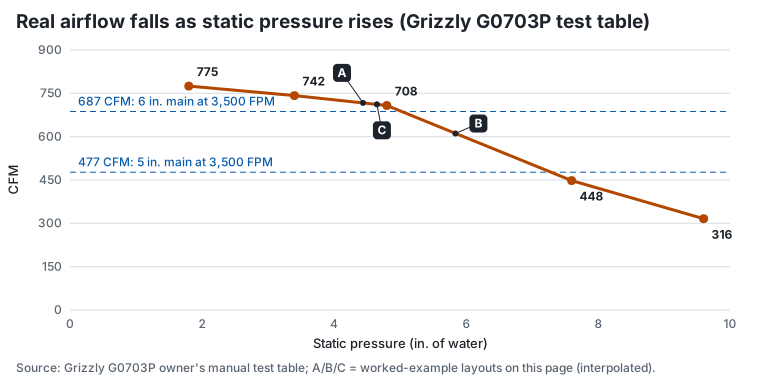
Every foot of duct, every elbow, and the filter add resistance, measured as static pressure in inches of water. As static pressure rises, a collector moves less air. Grizzly publishes the test data for its 1.5 HP G0703P cyclone, which makes the effect easy to see:[1]
| Static pressure (in. of water) | 1.8 | 3.4 | 4.8 | 7.6 | 9.6 |
|---|---|---|---|---|---|
| G0703P airflow (CFM) | 775 | 742 | 708 | 448 | 316 |
The spec-sheet headline for this collector is 775 CFM, the figure at 1.8 in.[1] A realistic garage run with a used filter lands around 4–5 in., where it moves about 710 CFM. Past about 5 in. the curve drops steeply. By 7.6 in. it has lost 42% of its headline airflow. Two habits push a run onto that steep part of the curve:
- Flex hose. In Grizzly's tables, 4 in. flex hose loses 0.28 in. per foot at branch speed, compared with 0.075 in. for 4 in. rigid duct, so each foot of flex costs about 3.7 times as much. Grizzly advises against more than 10 ft of flex on a line.[1]
- A dirty filter. Grizzly tells you to budget 1 in. for a seasoned filter so the system still works once the filter is no longer clean.[1] Oneida makes the same point from the other side: a cyclone that separates chips before the filter keeps airflow up.[2]
When you compare collectors, ask for the fan curve or test table, not just the maximum CFM. If a maker publishes only one CFM figure, you can't tell what you'll get at your static pressure.
Worked example: one 1.5 HP collector, three layouts
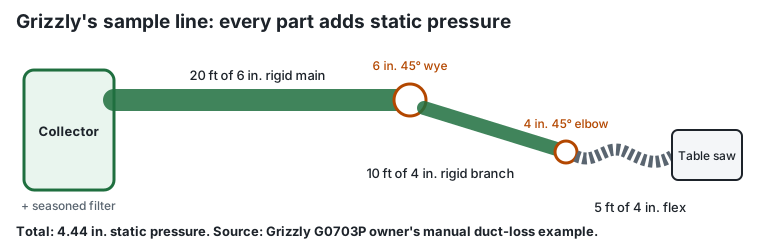
We started from Grizzly's own sample line (20 ft of 6 in. rigid main, 10 ft of 4 in. rigid branch, 5 ft of 4 in. flex, one 6 in. 45° wye, one 4 in. 45° elbow, seasoned filter), which totals 4.44 in.[1] We then changed one thing at a time, using the G0703P test table above and interpolating between its points:
| Layout (table saw, 400 CFM) | Static pressure | G0703P delivers (approx.) | Target | Result |
|---|---|---|---|---|
| A. Grizzly's example line, 6 in. main | 4.44 in. | 717 CFM | 687 CFM (6 in. main speed) | Meets it, with about 30 CFM to spare |
| B. Same, but 10 ft of flex instead of 5 | 5.84 in. | 611 CFM | 687 CFM | Falls short; the main runs below 3,500 FPM |
| C. Same as A, but a 5 in. main | 4.65 in. | 712 CFM | 477 CFM (5 in. main speed) | Meets it easily |
Two lessons. First, an extra 5 ft of flex hose can tip a marginal system from working to not working. Second, matching the main to the collector matters more than making it as large as possible. Also, a 14–20 in. planer with a 6 in. port needs about 850 CFM by Grizzly's chart.[1] That's more than this collector's highest published test point of 775 CFM, so a planer that size calls for a bigger collector, whatever the duct.
Shop vac or dust collector?
A shop vac and a dust collector solve different problems. Grizzly's chart puts 2 in. ports (miter saws, router tables, small sanders) at about 100 CFM, while 4 in. ports need about 400.[1] Small-port tools that need modest airflow suit a shop vac or dust extractor. Big-port chip makers such as planers, jointers, and table saws are what a dust collector is built for. Many small shops use both: a vac at the miter saw and sanders, a collector on the big machines.
Fine dust and filters
OSHA notes that breathing airborne wood dust may cause allergic and non-allergic respiratory symptoms and cancer.[4] The finest dust is the hardest to catch. Oneida recommends filtration near 100% down to 10 microns or less, and asking any maker what filter is supplied, what its efficiency rating is, and whether a third party tested it.[2] For reference, Grizzly lists the G0703P's canister at 0.2–2 micron filtration.[1] Collection at the machine doesn't catch everything, so wear a respirator for sanding.
Frequently asked questions
What size dust collector do I need for a table saw?
A typical table saw with a 4 in. port needs about 400 CFM at the machine by Grizzly's chart. Your collector target may be higher if your main duct is large: a 6 in. main needs about 690 CFM to stay at 3,500 FPM. Run your layout through the calculator.
Is a 1 HP dust collector enough for a small shop?
It can be, for a short run to one 4 in. port machine. Horsepower alone doesn't tell you. Compare the collector's published fan curve with the CFM and static pressure the calculator gives you.
Do I add up the CFM of all my machines?
Only for machines that run at the same time. With blast gates and one machine running at a time, size for the largest single machine.
What duct size should I use for a small shop?
Branches usually match the machine port (4 in. for most). Size the main so your collector can keep it above 3,500 FPM: about 477 CFM for 5 in. and 687 CFM for 6 in.
Why doesn't my dust collector pull as well as the CFM on the box?
The headline CFM is measured at low static pressure. Duct, flex hose, elbows, and a loaded filter add resistance. On Grizzly's published curve for a 1.5 HP collector, airflow falls from 775 CFM at 1.8 in. to 448 CFM at 7.6 in.
Sources
- Grizzly Industrial, Model G0703/G0703P 1-1/2 HP Cyclone Dust Collector owner's manual (Mfg. since 4/19): specifications, Figs. 37–47 (CFM by port, port size by machine, duct velocity rules, static pressure loss tables, performance curve). cdn3.grizzly.com/manuals/g0703p_m.pdf
- Oneida Air Systems, "4 Fundamentals of Workshop Dust Collection" (modified Jan 17, 2025). oneida-air.com/blog/4-things-every-good-dust-collector-needs
- Oneida Air Systems, "Airflow vs. Pipe Diameter." oneida-air.com/blog/airflow-vs-pipe-diameter
- OSHA, "Wood Dust" safety and health topic. osha.gov/wood-dust