
Flux-Core vs. MIG: Which Process Should a Beginner Start With?
Quick answer
- Start with self-shielded flux-core if you'll weld outdoors or in a drafty garage, mostly on 1/8 in. and thicker steel (gates, trailers, brackets, farm gear), and don't want to deal with a gas cylinder.[1]
- Start with gas MIG (solid wire) if you want to weld thin sheet metal such as auto body panels, care how the bead looks, weld indoors, or might weld aluminum later.[1][4]
- Can't decide? Buy a machine that does both, start with flux-core, and add gas later. Neither process is "stronger." Miller says both make sound welds when applied correctly.[1]
What actually differs: where the shielding comes from
Both processes feed a wire electrode through a gun from the same kind of machine. The difference is how the molten weld is protected from the air:
- MIG with solid wire uses shielding gas from a pressurized bottle. The most common mix is 75% argon / 25% CO2. Wind can blow the gas away, so outdoor work may need windshields.[1]
- Self-shielded flux-core wire has flux inside it. Burning the flux generates the shielding gas, so there's no tank, and it's well suited to outdoor or windy conditions.[1] It leaves slag on the bead that has to be chipped off.
- There is also gas-shielded flux-core, which uses both flux and a gas bottle. It's aimed at thicker metal and out-of-position work, and most beginners won't need it.[1] "Flux-core" on this page means the self-shielded kind.
Side-by-side comparison
| Factor | Self-shielded flux-core | Gas MIG (solid wire) |
|---|---|---|
| Shielding | From the burning flux; no tank[1] | Gas bottle, commonly 75/25 argon/CO2[1] |
| Wind and outdoors | Well suited[1] | Wind can strip the gas and cause porosity[1] |
| Rusty, mill-scaled, or oily steel | More tolerant: deoxidizers trap contaminants in the slag (cleaning is still the right practice)[1] | Needs cleaner metal[1] |
| Thin sheet (24–20 gauge) | Not recommended below 18 gauge (Hobart's chart)[4] | Clean welds down to 24 gauge, per Miller and Hobart[1][4] |
| Penetration | Excellent on 16 gauge and thicker; rounder profile with good sidewall fusion[1] | Deep root penetration[1] |
| Cleanup and looks | Slag to chip off | No slag; ready to paint; often neater beads[1] |
| Fume | Highest of the common arc processes[2] | Less than flux-core and stick[2] |
| Aluminum | Not possible[5] | Possible with aluminum wire and 100% argon[4] |
| Polarity (Hobart chart) | DCEN (electrode negative)[4] | DCEP (electrode positive)[4] |
| Strength | Neither is inherently stronger. Both make sound welds when applied correctly and within the right settings.[1] | |
What the manufacturers' charts reveal (our analysis)
1. Flux-core's real limit is thin metal
Hobart's weld-settings chart for its 120V Handler 140 lists starting settings by material and thickness.[4] Reading it row by row:
| Wire (Hobart Handler 140 chart) | Thinnest metal with a listed setting | Thickest listed |
|---|---|---|
| .030 in. flux-core (E71T-11), no gas | 18 gauge (.048 in.) | 1/4 in. (marked for multiple passes) |
| .035 in. flux-core, no gas | 16 gauge (.060 in.) | 1/4 in. |
| .024 in. solid wire, 75/25 gas | 24 gauge (.024 in.) | 12 gauge (.105 in.) |
| .030 in. solid wire, 75/25 gas | 24 gauge | 1/4 in. (marked for multiple passes) |
Hobart gives no flux-core settings for 20 or 24 gauge. The thinnest metal it lists for flux-core is 18 gauge, roughly twice the thickness of 24 gauge. Miller makes the same point in words: below 3/16 in. down to 24 gauge, solid wire produces a clean-looking weld, which is why auto body welders prefer it.[1] If your first project is rust repair on car panels, flux-core is the wrong starting point.
2. On the same 120V machine, flux-core reaches thicker steel
Lincoln's spec sheet for its 120V Easy-MIG 140 gives two different thickness claims for the same box: gas MIG from 24 gauge up to 3/16 in. in a single pass, and up to 5/16 in. with self-shielded flux-core wire.[3] That matches Miller's warning that .035 in. solid wire on a 115V circuit may lack the amperage for thicker material, risking cold lap or lack of fusion.[1] On a household-outlet welder, flux-core is the better choice for the heavy end of the range.
3. Fume is the indoor dealbreaker
OSHA ranks the common arc processes by fume, from most to least: flux-core, then stick, then gas MIG, then TIG.[2] In a garage attached to a house, that ranking matters more than bead looks. If you'll mostly weld indoors with the door half shut in winter, gas MIG makes the least fume of the three wire and stick options. With either process, clean coatings and residue off the metal first, as OSHA advises.[2]
4. A flux-only machine is a one-process purchase
Forney's 140 FC-i, for example, lists flux-cored as its only process ("no gas required").[6] Gas-capable 120V machines such as the Hobart Handler 140 and Lincoln Easy-MIG 140 ship with a gas regulator and hose. Hobart describes a quick polarity changeover for switching between solid and flux-cored wire.[3][4] The trade-off is weight: 50–57 lb for those two versus 19 lb for the Forney. See our five-welder spec comparison.
What you have to buy for each
| Item | Flux-core start | Gas MIG start |
|---|---|---|
| Machine | Flux-only or dual-process | Gas-capable (regulator often included, e.g. Hobart, Lincoln)[3][4] |
| Wire | Self-shielded flux-core (e.g. E71T-11 or E71T-GS), .030 or .035 in.[4][6] | ER70S-6 solid, .024–.035 in.[4] |
| Gas | None | Cylinder of 75/25 argon/CO2 (or 100% CO2, which Hobart also lists), set at 20–30 CFH per Hobart's chart[4] |
| Polarity | DCEN | DCEP[4] |
| Extra tools | Chipping hammer and wire brush for slag | Wind protection if outdoors[1] |
| Safety gear (both) | Auto-darkening helmet, welding gloves, flame-resistant clothing, ventilation, fire extinguisher | |
Decision table by project
| Your main project | Start with | Why |
|---|---|---|
| Auto body panels, sheet-metal patches | Gas MIG, .024 in. solid wire | Hobart lists settings down to 24 gauge only for solid wire; Miller notes auto body welders prefer it[1][4] |
| Fence, gate, trailer repair outdoors | Flux-core | Wind-tolerant and no tank to haul[1] |
| Rusty farm or yard equipment | Flux-core | More tolerant of rust and mill scale (still clean what you can)[1] |
| Brackets, carts, furniture in an attached garage | Gas MIG | Less fume indoors, no slag, paint-ready beads[1][2] |
| 1/4 in. steel on a 120V welder | Flux-core | Higher thickness claims on the same 120V machine (Lincoln: 5/16 in. vs 3/16 in.)[3] |
| Aluminum, now or later | Gas MIG machine | Flux-core can't weld aluminum; Hobart's chart lists aluminum with 100% argon[4][5] |
Most people land on "some of each." That points to a dual-process machine: Hobart Handler 140 or Lincoln Easy-MIG 140, or the multiprocess YesWelder covered in our welder comparison. If you're sure you'll only weld outdoors on thicker steel, a flux-only machine like the Forney Easy Weld 140 FC-i is enough. Bob Vila's testers named it their best overall beginner pick.[5]
The dual-process machines mentioned above
Welding
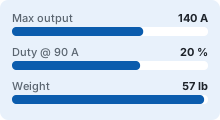
Hobart Handler 140
Best for: Learning gas MIG and flux-core on one 115V machine, with a regulator in the box.
- ProcessGas MIG + flux-core
- Output25-140 A on 115V
- Duty cycle20% at 90 A
- Steel thickness (maker)24 ga to 1/4 in.
- Weight57 lb
Welding
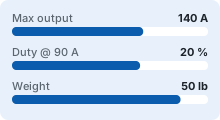
Lincoln Easy-MIG 140
Best for: Gas MIG on thin steel plus flux-core up to 5/16 in., with a shielding-gas kit included.
- ProcessGas MIG + flux-core
- Output30-140 A on 120V
- Duty cycle20% at 90 A
- Steel thickness (maker)24 ga-3/16 in. MIG; 5/16 in. flux-core
- Weight50 lb
Welding
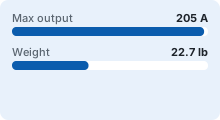
YesWelder MIG-205DS PRO
Best for: One machine for gas MIG, flux-core, lift TIG and stick, with a 220V option for thicker steel.
- ProcessesMIG, flux-core, lift TIG, stick
- Output30-160 A (110V); 30-205 A (220V)
- Duty cycle60% at 160 A (110V)
- Input110V or 220V
- Weight22.7 lb
Frequently asked questions
Is flux-core or MIG better for beginners?
It depends on the project. Flux-core is simpler to set up (no gas) and handles wind and rusty steel better. Gas MIG is better for thin sheet metal, neat beads, and indoor work. Many beginners buy a machine that does both.
Is flux-core stronger than MIG?
Neither is inherently stronger. Miller says both produce sound welds when applied correctly within the proper settings. Flux-core gives good sidewall fusion and penetration on 16 gauge and thicker steel, and solid wire gives deep root penetration.
Can I use flux-core wire in a MIG welder?
Many gas-capable 120V MIG welders run both. For example, Hobart's Handler 140 chart lists flux-core (DCEN, no gas) and solid wire (DCEP, with gas). You switch polarity and drive roll when you change wire.
Can flux-core weld thin sheet metal?
Not well. Hobart's chart for its 120V machine lists flux-core settings starting at 18 gauge, while solid wire with gas goes down to 24 gauge.
Why does flux-core make so much smoke?
The burning flux creates the shielding gas, and OSHA ranks flux-core arc welding highest in fume among common arc processes. Ventilate well, especially in an attached garage.
Sources
- Miller Electric, "Solid Wire Versus Flux-Cored Wire: When to Use Them and Why," posted Jul 16, 2024. millerwelds.com/…/solid-wire-versus-flux-cored-wire-when-to-use-them-and-why
- OSHA, "Controlling Hazardous Fume and Gases during Welding," Fact Sheet FS-3647. osha.gov/…/OSHA_FS-3647_Welding.pdf
- Lincoln Electric, Easy-MIG 140 (K2697-1) spec sheet, Publication E7.44, issued 08/13. ch-delivery.lincolnelectric.com/…
- Hobart Welding Products, Handler 140 spec sheet (Sept. 2022), including the Handler 140 Welding Guide chart: weldingsuppliesfromioc.com/…/Hobart_Handler_140_spec.pdf
- Glenda Taylor and Bob Beacham, "2026's Best Welders for Beginners, Tested and Reviewed," Bob Vila, published Sep 24, 2026. bobvila.com/reviews/best-welder-for-beginners/
- Forney Industries, 140 FC-i Welder spec sheet (Item #261). forneyind.com/…/261 - Spec Sheet.pdf