
Best MIG and Flux-Core Welders for Home Use: A Beginner's Spec Comparison
Quick answer: which one fits which beginner
- Cheapest way to start on a regular 120V outlet, no gas bottle: a flux-core-only machine such as the Forney Easy Weld 140 FC-i. Bob Vila's testers named it best overall for beginners.[5] It cannot run shielding gas, so it can never weld aluminum or produce gas-MIG-clean beads.
- Want to add gas MIG later without buying a new machine: Hobart Handler 140 or Lincoln Easy-MIG 140. Both run flux-core now and gas MIG later, and both ship with a gas regulator and hose.[2][3] Both are also around 50–57 lb, roughly three times the weight of the flux-only units.
- Want to learn MIG, stick, and TIG on one box, with 240V for thicker steel: YesWelder MIG-205DS series. Bob Vila tested the MIG-205DS-B and named it best multiprocess pick.[5] Check the input-current note below before plugging it into a household circuit.
- Lowest outlay to find out whether you like welding: Harbor Freight Titanium Easy-Flux 125, Bob Vila's budget pick, with the caveat that its testers found the welds sloppier.[5]
Welding fume from flux-core is the heaviest of the common arc processes, so plan ventilation before you buy (see fume and ventilation).[6]
How we chose and compared
- Scope: wire-feed welders a beginner can run from a standard 120V household outlet. We included flux-core-only machines, flux-core/gas-MIG machines, and one dual-voltage multiprocess machine.
- Specs come from each manufacturer's spec sheet or product page. Titanium Easy-Flux 125 specs are as published in Bob Vila's review.
- Review findings are summarized in our own words from Bob Vila's beginner-welder roundup (published September 24, 2026), whose testers welded with three of these machines in their shops.[5] That roundup does not cover the Hobart or the Lincoln, so those two are compared on specs. We do not reproduce anyone's scores or use retailer star ratings.
Spec table: five welders side by side
| Spec | Forney Easy Weld 140 FC-i[1] | Harbor Freight Titanium Easy-Flux 125[5] | Hobart Handler 140[2] | Lincoln Easy-MIG 140[3] | YesWelder MIG-205DS PRO[4] |
|---|---|---|---|---|---|
| Processes | Flux-core only | Flux-core only | Gas MIG + flux-core | Gas MIG + flux-core | Gas MIG, flux-core, lift TIG, stick |
| Input voltage | 120V | 120V | 115V | 120V | 110V or 220V |
| Output range (on 120V) | Up to 140 A | 30–125 A | 25–140 A | 30–140 A | 30–160 A (30–205 A on 220V) |
| Duty cycle at rated output | 30% at 90 A[5] | 30% at 90 A | 20% at 90 A | 20% at 90 A | 60% at 160 A (110V); 60% at 205 A (220V) |
| Input current | Not published (ships with a 20 A to 15 A adapter) | — | 20 A at rated output | 20 A at rated output | 50 A at 110V; 40 A at 220V (as listed) |
| Steel thickness (maker's claim) | Up to 1/4 in. | — (Bob Vila's testers welded up to 3/16 in.) | 24 ga to 1/4 in., single pass | 24 ga to 3/16 in. MIG, single pass; up to 5/16 in. flux-core | MIG up to 3/16 in. on 110V; up to 1/2 in. on 220V |
| Wire sizes | .030 in. recommended | — | .023–.035 in. solid; .030/.035 in. flux-core | .025–.035 in. | .023–.045 in. |
| Gas regulator included | No (no gas) | No (no gas) | Yes, dual-gauge regulator and hose | Yes, shielding-gas kit included | — |
| Weight | 19 lb | 15 lb | 57 lb | 50 lb | 22.7 lb |
| Warranty (as listed) | 1 year | — | 5/3/1 years by component | 3 years | 2 years |
What the specs reveal (our analysis)
1. Duty cycle in plain minutes
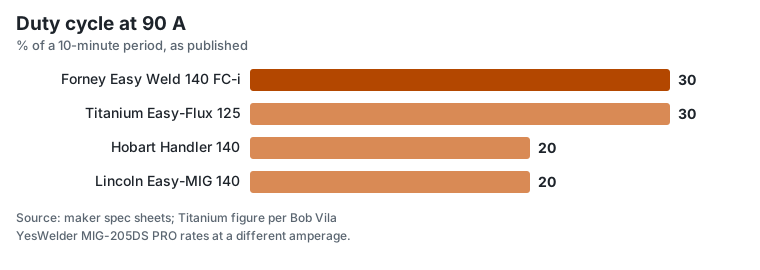
Duty cycle is the share of a 10-minute period a welder can run at a given output before it needs to cool; a 40% rating means 4 minutes on, 6 minutes off.[5] Converting each rating to minutes:
| Welder | Rated point | Arc-on minutes per 10 | Rest minutes per 10 |
|---|---|---|---|
| Forney Easy Weld 140 FC-i | 90 A | 3 | 7 |
| Harbor Freight Titanium Easy-Flux 125 | 90 A | 3 | 7 |
| Hobart Handler 140 | 90 A | 2 | 8 |
| Lincoln Easy-MIG 140 | 90 A | 2 | 8 |
| YesWelder MIG-205DS PRO, on 110V | 160 A (100% at 123 A) | 6 at 160 A; continuous at 123 A | 4 at 160 A; none at 123 A |
Two cautions. First, the ratings are stated at different amperages, so a 60% rating at 160 A is a much bigger capability gap than "60 versus 30" suggests. Second, for a beginner the gap matters less than it looks. Bob Vila's guide makes the same point: few people learning to weld hold a bead for more than a few minutes at a time.[5] Duty cycle starts to matter when you're running long seams on thicker steel near the top of the machine's range.
2. "Plugs into 120V" is not the whole power story
The Hobart and Lincoln each list 20 A of input current at rated output.[2][3] That points to a 20 A circuit with nothing else on it, not a shared 15 A garage outlet. Forney ships a 20 A–15 A plug adapter, which suggests the same.[1] YesWelder lists 50 A input current at 110V for the MIG-205DS PRO.[4] That is far above a household circuit, so check the manual before buying it for a garage outlet.
The same applies to generators. YesWelder says a generator is not recommended for the MIG-205DS PRO and, if one is used, calls for at least 10 kW, 120/240V, with automatic voltage regulation.[4] That is far beyond a suitcase inverter. If welding off a generator is part of your plan, see our inverter generator comparison.
3. Weight tells you what kind of buyer each machine is for
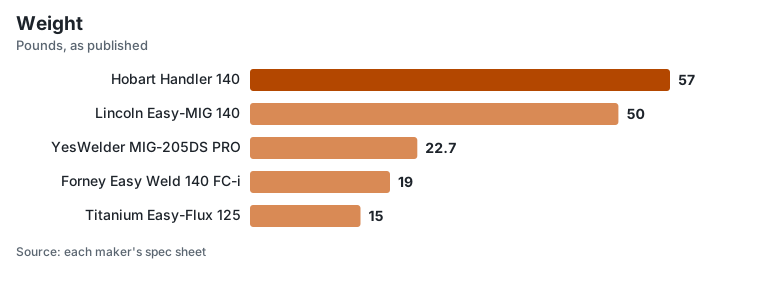
The two gas-capable 140 A machines weigh 50 lb (Lincoln) and 57 lb (Hobart). The flux-only 120V units weigh 15–19 lb. That makes the flux-only units about one-third the weight at similar maximum amperage.[1][2][3][5] The heavier machines are built to sit on a cart next to a gas cylinder. The light ones are built to be carried to a fence or trailer. The YesWelder, at 22.7 lb, gets gas capability at nearly flux-only weight.[4]
4. Thickness claims need reading closely
Forney claims up to 1/4 in., but Bob Vila's testers found the Easy Weld "most effective" on 1/8 in. steel.[1][5] Lincoln lists 24 gauge to 5/16 in., and its product info sheet splits that: 3/16 in. single pass with gas MIG, up to 5/16 in. with self-shielded flux-core wire.[3] Hobart claims 1/4 in. single pass.[2] On 120V, plan around 1/8–3/16 in. steel for comfortable, repeatable welds. Read the top-end numbers as the most the machine can do in good conditions, not as everyday performance.
5. Flux-core-only is a one-way door
Forney lists flux-cored as the 140 FC-i's only process ("no gas required"), and Bob Vila describes the Titanium the same way, with the flux-core wire making its own shielding gas.[1][5] Neither is sold as upgradeable to gas MIG, and flux-core cannot weld aluminum.[5] By contrast, the Hobart and Lincoln literature lists aluminum among the materials you can weld with gas MIG.[2][3] If you think you'll want gas MIG within a year or two, a flux-only machine is a stepping stone you'll replace, not a first stage you'll extend. More on choosing a process: flux-core vs. MIG.
Model-by-model: specs plus what reviewers found
Forney Easy Weld 140 FC-i: best-reviewed flux-only starter
Specs: flux-cored only; 120V input; 140 A output; .030 in. wire recommended; up to 1/4 in. plate; 19 lb; includes 8 ft gun, 8 ft ground clamp, and a 20 A–15 A adapter; 1-year warranty.[1] Duty cycle as published by Bob Vila: 30% at 90 A.[5]
What reviewers found: Bob Vila named it best overall for beginners after shop testing. Its testers described it as well made and portable, and said setup amounts to picking a voltage and a wire speed. They found its 10 wire-speed settings slow, which helps learners but frustrates experienced welders. They found it most effective on 1/8 in. steel and were able to run clean beads with little spatter after some practice.[5]
Watch for: no gas option, ever.
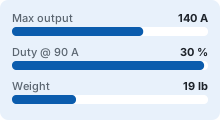
Welding
Forney Easy Weld 140 FC-i
Best for: Gasless flux-core welding on a 120V outlet with the least setup.
- ProcessFlux-core only
- OutputUp to 140 A on 120V
- Duty cycle30% at 90 A
- Steel thickness (maker)Up to 1/4 in.
- Weight19 lb
Harbor Freight Titanium Easy-Flux 125: lowest-commitment option
Specs (as published by Bob Vila): 30–125 A; 30% at 90 A; 15 lb.[5]
What reviewers found: Bob Vila made it the budget pick. Testers made adequate welds on steel up to 3/16 in., found it easy to set up with two dials, and said it was light enough to carry around. The downside they noted was sloppier welds, with more spatter and smoke, so they suggest using it outdoors. They found it did its best work on 1/8 in. steel.[5]
Watch for: sold only at Harbor Freight; welds were sloppier in Bob Vila's test.
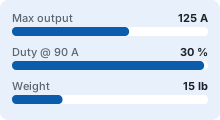
Welding
Titanium Easy-Flux 125
Best for: The lightest, simplest gasless welder for light repairs; sold only by Harbor Freight.
- ProcessFlux-core only
- Output30-125 A on 120V
- Duty cycle30% at 90 A
- Weight15 lb
Specs as published by Bob Vila.
Hobart Handler 140: gas-ready 120V machine with the broadest warranty
Specs: 115V; 25–140 A; rated 90 A at 18.5 V, 20% duty cycle; 20 A input at rated output; 24 ga to 1/4 in. steel in a single pass; five voltage settings and infinite wire speed; .023–.035 in. solid wire and .030/.035 in. flux-core; includes a dual-gauge regulator with gas hose and a 10 ft work cable; 57 lb; Hobart's 5/3/1 warranty (five years on transformers, stabilizers, and main rectifiers; three years on generators, PC boards, and drive systems; see Hobart for the full terms).[2]
Watch for: the heaviest machine here, and the 20% duty cycle is the joint-lowest.
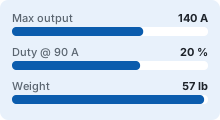
Welding
Hobart Handler 140
Best for: Learning gas MIG and flux-core on one 115V machine, with a regulator in the box.
- ProcessGas MIG + flux-core
- Output25-140 A on 115V
- Duty cycle20% at 90 A
- Steel thickness (maker)24 ga to 1/4 in.
- Weight57 lb
Lincoln Easy-MIG 140: gas-ready, with the highest flux-core thickness claim
Specs: 120V; 30–140 A; rated 90 A at 19.5 V, 20% duty cycle; 20 A input at rated output; MIG 24 ga to 3/16 in. single pass; up to 5/16 in. with self-shielded flux-core; two-knob control; includes a Magnum 100L gun with 10 ft cable, a shielding-gas kit, and sample spools of MIG and flux-core wire; .025–.035 in. wire; 50 lb; 3-year warranty. Aluminum needs the optional spool gun.[3]
Watch for: same duty cycle as the Hobart, at a similar weight.
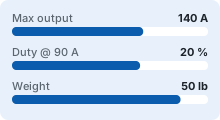
Welding
Lincoln Easy-MIG 140
Best for: Gas MIG on thin steel plus flux-core up to 5/16 in., with a shielding-gas kit included.
- ProcessGas MIG + flux-core
- Output30-140 A on 120V
- Duty cycle20% at 90 A
- Steel thickness (maker)24 ga-3/16 in. MIG; 5/16 in. flux-core
- Weight50 lb
YesWelder MIG-205DS series: multiprocess and dual-voltage
Specs (MIG-205DS PRO, YesWelder's current listing): 110V or 220V; MIG, flux-core, lift TIG, and stick; MIG 30–160 A on 110V and 30–205 A on 220V; MIG duty cycle 60% at 160 A and 100% at 123 A on 110V, 60% at 205 A on 220V; MIG on steel up to 3/16 in. on 110V and 1/2 in. on 220V; .023–.045 in. wire; spool-gun compatible; TIG torch sold separately; input current 50 A at 110V and 40 A at 220V; 22.7 lb; 2-year warranty.[4]
What reviewers found: Bob Vila tested the MIG-205DS-B and named it best multiprocess pick. Its testers found it more user-friendly than its three processes suggest: a single button selects the process and many setup functions are semi-automated. They noted that it runs on 110V or 220V and that its duty cycle is longer than many similar welders. They could not test TIG because the torch is not included.[5] Specs above are for the MIG-205DS PRO, the sibling model YesWelder currently lists.
Watch for: the input-current and generator notes in our analysis above.
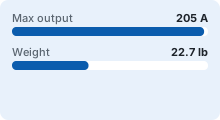
Welding
YesWelder MIG-205DS PRO
Best for: One machine for gas MIG, flux-core, lift TIG and stick, with a 220V option for thicker steel.
- ProcessesMIG, flux-core, lift TIG, stick
- Output30-160 A (110V); 30-205 A (220V)
- Duty cycle60% at 160 A (110V)
- Input110V or 220V
- Weight22.7 lb
Fume and ventilation in a home garage
OSHA's fact sheet on welding fume ranks the common arc processes by how much fume they make. Flux-core arc welding (FCAW) is at the top, followed by stick, then gas MIG, then TIG.[6] Welding fume can contain metals such as manganese, chromium, and nickel, plus gases including carbon monoxide and ozone.[6] For a home garage, that means:
- Flux-only machines are cheapest to start with but make the most fume. Weld with the garage door open and air moving away from your face.
- Clean paint, solvent residue, and other coatings off the metal before welding, as OSHA advises.[6]
- Keep a fire extinguisher nearby and clear sawdust and other combustibles from the area. Spatter travels.
If your garage is also a woodshop, see our dust collection guides. Fine wood dust and welding sparks don't mix.
Buying checklist for a first welder
- Decide on gas now. Gasless only, or gas MIG later? That one decision cuts this list in half.
- Check the circuit. Find the input current at rated output in the spec sheet and compare it with the breaker on the outlet you plan to use. Avoid extension cords unless the manual allows a specific gauge and length.
- Match thickness to your projects. On 120V, plan on 1/8–3/16 in. steel for everyday work. If you'll regularly weld 1/4 in. or thicker, consider a dual-voltage machine and a 240V circuit.
- Budget for gear. You'll need an auto-darkening helmet, gloves, flame-resistant clothing, wire, and, for gas MIG, a shielding-gas cylinder. No machine here includes a gas cylinder.
- Plan ventilation as described above, especially for flux-core.
Frequently asked questions
What is the best welder for a beginner at home?
If you want gasless welding on a 120V outlet with the least setup, the Forney Easy Weld 140 FC-i was Bob Vila's top beginner pick after shop testing. If you expect to want gas MIG, a gas-ready machine like the Hobart Handler 140 or Lincoln Easy-MIG 140 avoids buying twice.
Can I run a MIG welder on a regular household outlet?
Many 140 A machines are designed for 120V, but the Hobart and Lincoln each list 20 A of input current at rated output, so use a dedicated 20 A circuit. Check the manual for breaker size and extension cord limits.
Is flux-core or MIG better for beginners?
Flux-core is cheaper and simpler (no gas cylinder), but it makes more fume than gas MIG, per OSHA. In Bob Vila's testing the budget flux unit also made more spatter. Flux-core cannot weld aluminum. Gas MIG gives cleaner welds on thin steel and opens up aluminum with the right setup.
What does a 20% duty cycle at 90 amps mean?
At 90 A, the welder can run for 2 minutes out of every 10 and then needs 8 minutes to cool. At lower amperage it can run longer.
How thick can a 120V welder weld?
Makers on our list claim up to 1/4 in. (and 5/16 in. for Lincoln with flux-core). In testing, Bob Vila found the Forney most effective on 1/8 in. steel. Plan on 1/8–3/16 in. for everyday work.
Sources
- Forney Industries, 140 FC-i Welder spec sheet (Item #261, P-10874 7/21/20). forneyind.com/…/261 - Spec Sheet.pdf
- Hobart Welding Products, Handler 140 spec sheet (Sept. 2022) and product page. Spec sheet: Hobart_Handler_140_spec.pdf
- Lincoln Electric, Easy-MIG 140 (K2697-1) product page and its linked product info sheet
- YesWelder, "Compare MIG Welders" (MIG-205DS PRO column). yeswelder.com/compare/mig-welder
- Glenda Taylor and Bob Beacham, "2026's Best Welders for Beginners, Tested and Reviewed," Bob Vila, published Sep 24, 2026. bobvila.com/reviews/best-welder-for-beginners/
- OSHA, "Controlling Hazardous Fume and Gases during Welding," Fact Sheet FS-3647. osha.gov/…/OSHA_FS-3647_Welding.pdf