Backup Power guide
Generator vs. Portable Power Station for Home Backup: Runtime Calculator
Quick answer
- Choose a power station for outages of hours to about a day, for indoor use, and for quiet loads such as a modem, lights, phones, a CPAP, and a fridge. It makes no exhaust, so it can sit inside. The CPSC says a portable generator must never run indoors or in a garage.[8]
- Choose a generator for outages of several days, and for well pumps, central AC, or electric water heating. One 7.1 gal tank in a DuroMax XP11000iH runs 18 hours at quarter load.[9] By our arithmetic, that's about 40 kWh, roughly ten times the rated 4,096 Wh of the large EcoFlow DELTA Pro 3.[3]
- Check two numbers on a power station: watt-hours (how long it lasts) and continuous watts (what it can run at once). Expect about 85% of the rated watt-hours to reach your appliances.[4][5]
- Many households end up with both: a power station for the first quiet hours and overnight, and a generator outdoors that can recharge it during a long outage.
Already sized your loads? Our generator wattage calculator uses the same appliance figures as the calculator below.
Power station runtime calculator
Pick a power station or type in your own, tick what you'd run, and set hours per day. For a fridge or freezer, type the kWh per year from its yellow EnergyGuide label; compressors cycle on and off, so the label is a better guide than running watts. Running and starting watts are the same figures as in our generator calculator, and they're used only to check what can run at once. The default hours are examples: change them to match your house. Everything runs in your browser.
| Item | Qty | Running W | Starting W | Daily use |
|---|---|---|---|---|
| Loading calculator… | ||||
Generator vs. power station, side by side
| Question | Portable generator | Portable power station |
|---|---|---|
| Where it can run | Outdoors only, far from windows, doors and vents[8] | Indoors; no exhaust[5] |
| How long it lasts | As long as you refuel. Examples: 18 h per 7.1 gal tank at 1/4 load (XP11000iH); 8.1 h per 0.95 gal at 1/4 load (Honda EU2200i)[9][10] | One charge: 768 to 4,096 Wh rated for the three models here, about 85% of that usable[1][3][4] |
| Energy per fill or charge (our arithmetic) | About 40 kWh per tank (XP11000iH at 1/4 load); about 3.6 kWh per tank (EU2200i at 1/4 load) | About 0.65 to 3.5 kWh usable per charge for these three |
| Output at once | 1,800 to 9,000 running W for the three models here[9][10][11] | 800 to 4,000 W continuous, 1,600 to 8,000 W surge[1][3] |
| 240V loads (well pump, central AC) | Large 120/240V models[9] | Only the biggest units (DELTA Pro 3 here)[3] |
| Recharge or refuel | Gasoline or propane, refilled with the engine off | Wall outlet, solar panels, a car, or a generator; River 2 Pro is rated 0-100% in 70 minutes on AC[1] |
| Noise | Example: 61 dBA at 23 ft (Champion 201319)[11] | Reviewers note quiet operation[5] |
| Upkeep | Oil changes, fuel stabilizer, regular test runs | Keep charged; battery rated 3,000 to 4,000 cycles to 80% for these three[1][2][3] |
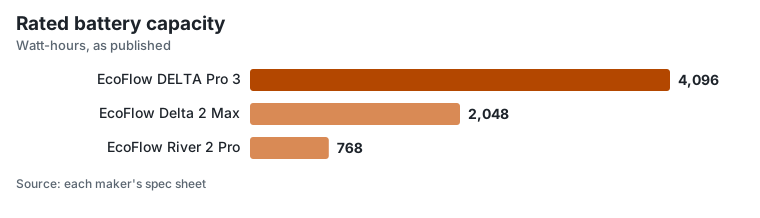
What the numbers show (our analysis)
Watts and watt-hours answer different questions
A generator's rating tells you what it can run at once, and fuel decides how long. A power station needs two ratings. Continuous watts set what can run at once, like a generator's running watts. Watt-hours set how long it lasts. A 2,048 Wh unit running a steady 200 W load lasts about 2,048 × 0.85 ÷ 200 ≈ 8.7 hours, using EcoFlow's rule of thumb.[4] Expansion batteries add watt-hours but don't raise the output limit, as EcoFlow points out.[4]
About 85% of the battery reaches your appliances
Power stations lose energy converting battery power to 120V AC. EcoFlow's runtime guide uses 85%.[4] OutdoorGearLab measured the AC energy each of 14 power stations delivered and found 75% to 93% of the rated capacity. Some examples:[5]
- EcoFlow River 2 Pro: 620 of 768 Wh
- Jackery Explorer 2000 v2: 1,710 of 2,042 Wh
- EcoFlow DELTA Pro 3: 3,790 of 4,096 Wh
The calculator defaults to 85%. Set it lower if you want a margin for cold weather or an older battery.
The fridge is the hard part
A fridge's running watts tell you whether the station can start it. Its daily energy tells you how long the station lasts. The Department of Energy's example of an 18.1 cu. ft. ENERGY STAR top-freezer model uses 363.5 kWh a year,[7] or about 1 kWh a day, an average of roughly 42 W. Real use can be far higher. OutdoorGearLab reports the DELTA Pro 3 ran its test fridge for 19 hours.[5] At the 3,790 Wh it measured from that unit, that's an average of roughly 200 W by our arithmetic, nearly five times the label example. We don't know what fridge it used. Door openings, a warm kitchen, and a bigger or older fridge all push the number up. Wirecutter found the 768 Wh River 2 Pro could run a full-size fridge.[6] Use the label figure as a best case, and plan with a margin.
A tank of fuel holds far more energy than a charge
The XP11000iH is rated for 18 hours on 7.1 gal at quarter load.[9] A quarter of 9,000 W for 18 hours is 40,500 Wh. The small Honda EU2200i is rated for 8.1 hours on 0.95 gal at quarter load,[10] about 3,600 Wh by the same arithmetic: more than a full Delta 2 Max charge (2,048 Wh rated), from under a gallon. That's why multi-day outages favor generators. A power station needs a fresh charge every day or so, from the grid, solar, or a generator running outside.
The essentials list and 240V loads
Our generator calculator's default essentials list (fridge, 1/2 hp furnace fan, 1/2 hp sump pump, ten LED bulbs, TV, modem, chargers) comes to 2,995 running W and 4,470 W at start-up.[12] Of the three reference stations, only the DELTA Pro 3 (4,000 W continuous, 8,000 W surge) can run that whole list at once. The Delta 2 Max's 2,400 W means taking turns: the sump pump and furnace fan can't both run while everything else is on. EcoFlow says the DELTA Pro 3's 240V output can run a 3-ton central AC.[3] But a 3-ton unit at 3,500 running W, plus the 2,995 W essentials, adds up to more than 4,000 W. As on our generator page, central AC on top of essentials belongs in the 9,000 W generator class.
Three reference power stations
These are reference points for each size class, chosen because Wirecutter or OutdoorGearLab tested them, not a ranked list. All three are EcoFlow because that's where the independent test data overlapped. OutdoorGearLab's tested picks also include Jackery and Anker models.[5]
Small: EcoFlow River 2 Pro
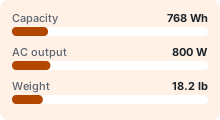
Specs: 768 Wh, 800 W continuous (1,600 W surge) at 120V, about 18.2 lb, LFP battery rated for 80%+ capacity after 3,000 cycles, 0-100% on AC in 70 minutes.[1]
What reviewers found: Wirecutter (updated June 24, 2026) names it the best portable power station for most people. In its tests, it ran even a full-size fridge, and the maximum output measured was 851 W.[6] OutdoorGearLab measured 620 Wh of AC output.[5]
Availability: on Oct. 17, 2026, EcoFlow's US store listed every River 2 Pro bundle as sold out, and Amazon's listing showed it as currently unavailable. Treat it as a size reference: other 700 to 1,000 Wh units are compared in the OutdoorGearLab test.[5]
Fits: a modem, lights, phones, and a CPAP overnight. With the default list in the calculator (fridge, lights, modem, chargers, TV), it lasts about 4 hours, and the list is more than its 800 W can run at once.
Backup Power
EcoFlow River 2 Pro
Best for: Indoor backup for a modem, lights, phones and a CPAP; too small to run a fridge plus a TV at once.
- Capacity768 Wh
- AC output800 W (surge 1,600 W), 120V
- WeightAbout 18.2 lb
- BatteryLFP, 80%+ after 3,000 cycles
- AC recharge0-100% in 70 min (maker)
Mid-size: EcoFlow Delta 2 Max
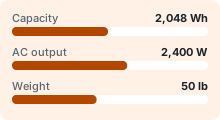
Specs: 2,048 Wh (expandable with extra batteries), 2,400 W continuous (4,800 W surge), 50 lb, LFP battery rated for 3,000 cycles to 80%+.[2]
What reviewers found: Wirecutter's upgrade pick. It measured a maximum output of 2,405 W and ran a fan for 19 hours. It notes the unit is at the top of its 50 lb weight limit.[6]
Fits: a fridge, lights, internet, and a TV for about 11 hours on the calculator's default list. That's an overnight bridge, not a weekend.
Backup Power
EcoFlow Delta 2 Max
Best for: A fridge, lights, internet and a TV for most of a day, on 120V outlets only.
- Capacity2,048 Wh (expandable)
- AC output2,400 W (surge 4,800 W), 120V
- Weight50 lb
- BatteryLFP, 3,000 cycles to 80%+
Large, 120/240V: EcoFlow DELTA Pro 3
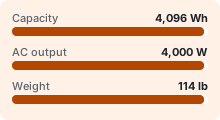
Specs: 4,096 Wh (expandable), 4,000 W continuous (8,000 W surge), 120/240V output, 113.5 lb, LFP battery rated for 4,000 cycles to 80%. The warranty is 3 years, plus 2 more if you register it in EcoFlow's app.[3]
What reviewers found: OutdoorGearLab picked it as best for home backup (updated July 23, 2026). It measured 3,790 Wh of AC output and reported 19 hours on its test fridge. It called the unit impractical for camping at 114.1 lb, and noted EcoFlow's optional transfer-switch kit for powering chosen home circuits.[5]
Fits: a house that wants the generator calculator's whole essentials list from a battery, with a transfer switch installed by an electrician. It lasts about 22 hours on the power station calculator's default list.
Backup Power
EcoFlow DELTA Pro 3
Best for: Whole-day essentials including 240V loads, if you can move a 113 lb unit and wire it in through a transfer switch.
- Capacity4,096 Wh (expandable)
- AC output4,000 W (surge 8,000 W), 120/240V
- Weight113.5 lb
- BatteryLFP, 4,000 cycles to 80%
- Warranty5 years (3 standard + 2 on app registration)
Three reference generators
These come from our inverter generator comparison, where you'll find the review findings for each.
Backup Power
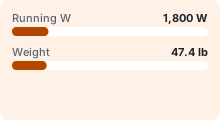
Honda EU2200i
Best for: A fridge, lights and phones, or one half of a quiet parallel pair.
- Running W (gas)1,800 W
- Voltage120V
- Noise48-57 dB(A)
- Dry weight47.4 lb
- Run time at 1/4 load8.1 h (0.95 gal)
Backup Power
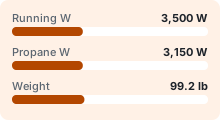
Champion 201319
Best for: 120V essentials (fridge, sump, furnace fan, lights) on gas or propane.
- Running W (gas)3,500 W
- Running W (propane)3,150 W
- Voltage120V (TT-30R RV outlet)
- Dry weight99.2 lb
- Noise61 dBA at 23 ft
Backup Power
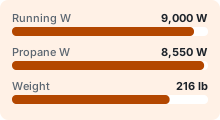
DuroMax XP11000iH
Best for: All-round 240V home backup on gas or propane, with the smallest propane drop on our list.
- Running W (gas)9,000 W
- Running W (propane)8,550 W
- Voltage120/240V
- Dry weight216 lb
- Run time at 25%18 h (7.1 gal)
Which one fits your outage
| Your situation | Start with | Why |
|---|---|---|
| Apartment or condo, short outages | Small or mid-size power station | Runs indoors; no fuel storage |
| CPAP, modem, and lights overnight | Small power station | Low, steady loads suit a small battery |
| Fridge plus essentials for a day | Mid-size or large power station | Needs about 2 kWh or more per day; check the label |
| Sump pump or well pump | Generator, or a large 120/240V station | Big start-up surges; well pumps are often 240V |
| Outages lasting several days | Generator (optionally plus a station) | Refueling beats waiting on a recharge |
| Central AC or electric water heater | 9,000 W class 120/240V generator | Over any single power station's output here once essentials are added |
Frequently asked questions
Is a portable power station better than a generator for home backup?
For short outages and indoor use, often yes: it's quiet and makes no exhaust. For multi-day outages or 240V loads, a generator holds far more energy per tank and can be refueled. A 7.1 gal XP11000iH tank at quarter load is about 40 kWh, versus 4,096 Wh rated for a DELTA Pro 3.
How long will a 1,000 Wh or 2,000 Wh power station run a refrigerator?
It depends on the fridge's daily energy. Take about 85% of the rated Wh and divide by the fridge's average draw. On the DOE's ENERGY STAR example (about 1 kWh a day), a 2,048 Wh unit could last around 40 hours on the fridge alone. OutdoorGearLab's test fridge drew far more: a 4,096 Wh unit ran it for 19 hours. Read your fridge's EnergyGuide label and plan with a margin.
Can a power station run a whole house?
Not a typical whole house. The largest model here gives 4,000 W continuous at 120/240V, enough for the essentials list in our generator calculator, but not central AC on top of it. Expansion batteries add hours, not watts.
Can I use a power station indoors?
Yes. It burns no fuel and makes no carbon monoxide. A gasoline or propane generator must never run indoors, in a garage, or in a basement. The CPSC says to keep it outside, away from windows, doors, and vents.
Can I recharge a power station from a generator?
Yes, plug the station's AC charger into the generator running outdoors. That's a common way to stretch a long outage: run the generator for a few hours, then run quietly on the battery overnight.
Sources
- EcoFlow, River 2 Pro Portable Power Station product page and specifications. us.ecoflow.com/products/river-2-pro-portable-power-station
- EcoFlow, Delta 2 Max Portable Power Station product page and specifications. us.ecoflow.com/products/delta-2-max-portable-power-station
- EcoFlow, DELTA Pro 3 Portable Power Station product page and specifications. us.ecoflow.com/products/delta-pro-3-portable-power-station
- EcoFlow (Ireland site), FAQs: "How do I estimate runtime?" and "Do I need an Extra Battery to run higher-powered appliances?" ecoflow.ie/faqs/
- RJ Spurrier, "The Best Power Stations," OutdoorGearLab, updated July 23, 2026 (14 units bought and measured). outdoorgearlab.com/topics/camping-and-hiking/best-power-station
- Sarah Witman, "The Best Portable Power Station," Wirecutter (The New York Times), updated June 24, 2026. nytimes.com/wirecutter/reviews/best-portable-power-stations/
- U.S. Department of Energy, Federal Energy Management Program, "Purchasing Energy-Efficient Residential Refrigerators" (Table 1, 18.1 cu. ft. top-freezer example). energy.gov/cmei/femp/purchasing-energy-efficient-residential-refrigerators
- U.S. Consumer Product Safety Commission, "Generators and Engine-Driven Tools." cpsc.gov/…/Generators-and-Engine-Driven-Tools
- DuroMax Power Equipment, XP11000iH product page and specifications. duromaxpower.com/products/duromax-xp11000ih-…
- Honda Power Equipment, EU2200i product page and specifications. powerequipment.honda.com/generators/models/eu2200i
- Champion Power Equipment, 201319 4,500 W dual-fuel inverter product page. championpowerequipment.com/product/201319-…
- ShopToolSpecs, What Size Generator Do I Need? Home Backup Wattage Calculator (default essentials list and the Honda and Champion chart figures behind it).