What Size Generator Do I Need? Home Backup Wattage Calculator
Quick answer
Size a generator to the things you will actually run at the same time during an outage, not to your house or your electrical panel. Then check two numbers: running watts (what everything draws once it is on) and starting watts (the short surge a motor needs to start).
- Essentials only (refrigerator, gas-furnace fan, sump pump, ten LED bulbs, internet, TV, chargers): about 3,000 running watts and 4,500 starting watts using the cautious chart figures in our calculator. That fits a mid-size 120V inverter rated about 3,500 running / 4,500 starting watts, such as the Champion 201319, with a little less than 20% headroom on gasoline.[9]
- Central AC, an electric water heater, an electric dryer, or a well pump each add thousands of watts and usually need 240V. With those you need a 120/240V generator: about 5,500 running watts covers a fridge, furnace fan, lights and a 1 hp well pump; add a sump pump and TV and you need about 6,000 running watts, which means the 9,000 W class. Central AC or an electric water heater on top of essentials also lands in the 9,000 W class; more than one big 240V load at once calls for a standby generator.
Home backup wattage calculator
Tick what you need to run during an outage, set quantities, and edit any wattage to match your appliance's nameplate. Defaults are the higher of the Honda and Champion published figures (see why). Everything runs in your browser.
| Item | Qty | Running W | Starting W |
|---|---|---|---|
| Loading calculator… | |||
How the math works
Running watts are what a device draws once it is going. Starting watts are the brief extra draw some devices, mainly anything with a motor or compressor, need to get moving. Champion estimates starting watts at 1–2 times running watts[4], and one Champion manual warns they "can exceed three times the running watts."[5] Champion's help center gives a 1-hp capacitor-start motor as an example: about 1,500 W running but about 4,500 W to start.[6]
The calculator does three things:
- Running watts needed = the sum of running watts × quantity for everything ticked.
- Starting watts needed:
- Standard: running total + the largest single start-up surge (that item's starting watts minus its running watts). This assumes, as Honda recommends, that you don't start every motor at the same moment. Honda's own example of a fridge, furnace, lights, TV, and microwave needs only 1,400 continuous watts when the motors start one at a time.[2]
- Conservative: running total + the highest single starting-watt figure. This is the method printed on Champion's sizing flyer[4]. It counts that item's running watts twice, so it adds a built-in safety margin.
- Running watts to shop for = running watts needed plus your headroom percentage. The 20% default is our judgment, not a manufacturer rule. It covers chart error, the item you forgot, and a little growth. Honda's EU2200i owner's manual says "for continuous operation, do not exceed the rated power"[8], so the running rating is the number that has to clear your load, not the peak rating.
Worked example: a typical "keep the house safe" list
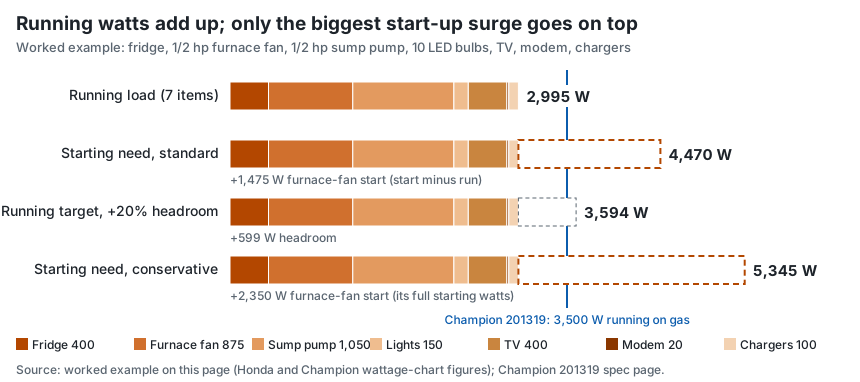
These are the calculator's default ticks. The numbers are the cautious chart figures, not measurements of any particular appliance.
| Item | Running W | Starting W | Start-up surge (start − run) |
|---|---|---|---|
| Refrigerator | 400 | 1,200 | 800 |
| Furnace fan, 1/2 hp | 875 | 2,350 | 1,475 (largest) |
| Sump pump, 1/2 hp | 1,050 | 2,150 | 1,100 |
| 10 LED bulbs | 150 | 150 | 0 |
| TV | 400 | 400 | 0 |
| Modem/router | 20 | 20 | 0 |
| Phone and laptop charging | 100 | 100 | 0 |
| Total | 2,995 |
- Starting watts, standard: 2,995 + 1,475 = 4,470 W.
- Starting watts, conservative (Champion method): 2,995 + 2,350 = 5,345 W.
- Running watts to shop for (20% headroom): 2,995 × 1.2 ≈ 3,594 W.
What that means in real generators: a 120V inverter rated 3,500 running / 4,500 starting watts on gasoline, such as Champion's 201319[9], covers the running load and the standard starting figure. It falls just short of the 20% headroom target, and on propane (3,150 running watts) it gives up more margin. If your fridge is an Energy Star model, Honda's chart puts it at only 132–192 running watts[1], which brings the total down about 200 W. Check your nameplates before you upsize.
Where the manufacturer charts disagree, and why our defaults lean high
We put Honda's wattage chart[1] next to Champion's[3][4] for every item in the calculator. They often disagree, sometimes by a factor of ten:
- Dishwasher: Honda lists 216 W running for a "cool dry" cycle; Champion lists 1,200–2,400 W. The heating element is the difference. Air-dry settings matter during an outage.
- Refrigerator: Honda's Energy Star figure is 132–192 W running; Champion's range runs up to 400 W. Older fridges sit at the high end.
- Desktop computer: Honda says 600–800 W; Champion's flyer says 100 W. A modern laptop-class PC is far closer to the low figure.
- Furnace fan, 1/2 hp: Honda's starting figure (2,350 W) is well above Champion's (800–1,600 W).
Because undersizing is the expensive mistake (a generator that stalls when the sump pump kicks on), the calculator defaults to the higher published figure for each item. Edit any row down if your nameplate says less.
| Item | Honda chart (run / start, W) | Champion chart (run / start, W) | Our default (run / start, W) |
|---|---|---|---|
| Kitchen | |||
| Refrigerator | 132–192 run / 1,200 start (Energy Star fridge or freezer) | 150–400 run / 800–1,200 start | 400 / 1,200 |
| Chest or upright freezer | 132–192 / 1,200 (listed with refrigerator) | 100–500 / 500–1,000 | 500 / 1,200 |
| Microwave (1,000 W) | 1,500 / 1,500 (1,000-W oven) | 600–1,200, no extra starting watts | 1,500 / 1,500 |
| Coffee maker | 600 / 600 (4-cup) | 800 (flyer), no extra starting watts | 800 / 800 |
| Air fryer | not listed | 1,500 (flyer), no extra starting watts | 1,500 / 1,500 |
| Electric range, one burner | 2,100 / 2,100 (8-in. element, marked 240V) | 1,200–2,400, no extra starting watts | 2,400 / 2,400 |
| Dishwasher | 216 run / 540 start (cool dry) | 1,200–2,400, no extra starting watts | 2,400 / 2,400 |
| Heating, cooling & water | |||
| Furnace fan, 1/3 hp (gas or oil furnace) | 700 / 1,400 | not listed at 1/3 hp | 700 / 1,400 |
| Furnace fan, 1/2 hp (gas or oil furnace) | 875 / 2,350 | 300–800 / 800–1,600 | 875 / 2,350 |
| Sump pump, 1/3 hp | 800 / 1,300 | 500–800 / 1,000–1,600 | 800 / 1,600 |
| Sump pump, 1/2 hp | 1,050 / 2,150 | 800–1,050 / 1,300–2,150 | 1,050 / 2,150 |
| Well pump, 1/2 hp | not listed | 750–1,000 / 1,500–2,000 | 1,000 / 2,000 |
| Well pump, 1 hp | not listed | 1,000–2,000 / 2,000–4,000 | 2,000 / 4,000 |
| Window AC, 5,000 BTU | not listed | 450–600 / 900–1,200 | 600 / 1,200 |
| Window AC, 10,000 BTU | 1,500 / 2,200 | 900–1,200 / 1,800–2,400 | 1,500 / 2,400 |
| Central AC, 3 ton | not listed | 3,000–3,500 / 5,000–6,000 | 3,500 / 6,000 |
| Electric water heater | 4,500 / 4,500 (marked 240V) | 3,000–4,500, no extra starting watts | 4,500 / 4,500 |
| Portable space heater | not listed (1,300 radiant heater, recreational table) | 750–1,500, no extra starting watts | 1,500 / 1,500 |
| Laundry | |||
| Washing machine | 1,200 / 1,200 | 500–1,000 / 1,000–2,300 | 1,200 / 2,300 |
| Electric clothes dryer | 5,400 / 6,750 (marked 240V) | 4,000–6,000, no extra starting watts | 6,000 / 6,750 |
| Everyday essentials | |||
| LED light bulb (each) | incandescent: as marked on bulb | 8–15 per bulb | 15 / 15 |
| Ceiling fan | not listed | 15–75 | 75 / 75 |
| TV (32–55 in.) | 120–190 (20–46 in. flat screen) | 80–400 | 400 / 400 |
| Internet modem/router | not listed | 10–20 | 20 / 20 |
| Phone and laptop charging | laptop 200–250 | 20–100 | 100 / 100 |
| Desktop computer | 600–800 | 100 (flyer) | 800 / 800 |
| CPAP with heated humidifier | not listed | 60–120 | 120 / 120 |
| Home security system | not listed | 15–40 | 40 / 40 |
| Garage door opener | 720 / 1,420 | not listed | 720 / 1,420 |
| Hair dryer (1,600 W) | 1,800 / 1,900 | not listed | 1,800 / 1,900 |
Reading your own appliance nameplates
Charts are averages. The label on your appliance (usually inside the fridge door, on the back, or on the motor housing) is better.
- If it lists watts, use that as running watts.
- If it lists volts and amps, multiply them: volts × amps = watts, the same formula in Champion's manuals[7]. A 120V motor labeled 6.5 A runs at about 780 W.
- Labels rarely give starting watts. For motors and compressors, use the chart figure or assume 2–3× running[4][5].
- Check the voltage. 240V items, such as dryers, ranges, water heaters, central AC, and many well pumps, need a 120/240V generator and a proper transfer switch or interlock.
Sizing for the questions people actually ask
"What size generator for 200-amp service?"
A 200-amp panel describes how much the service can carry, not what you use. The math: 200 A × 240 V = 48,000 W of capacity. The largest portable in our reference set, the Westinghouse WGen9500DF, is rated 9,500 running watts[11], about one-fifth of that. That is fine, because no house runs anywhere near its panel rating during an outage. Size to your list of essentials with the calculator, and ignore the panel number.
"What size generator to run a whole house?"
"Whole house" usually means central AC, an electric water heater, an electric range, and a dryer, all 240V and each in the thousands of watts. Tick them in the calculator: central AC (3 ton) plus a water heater alone is up to 8,000 running watts on Champion's chart[3] before anything else. Most households either run a large 120/240V portable through a transfer switch and take turns with big loads, or move to a permanently installed standby generator sized by a dealer.
"What size generator to run a fridge?"
A refrigerator alone needs about 132–400 running watts and 800–1,200 starting watts on the two charts[1][3]. That is within a 2,000–2,200 W-class inverter, and Honda lists a fridge among the EU2200i's applications[8].
"What size generator to run an air conditioner?"
A 10,000-BTU window unit needs about 1,500 running and 2,200–2,400 starting watts[1][3], so a mid-size inverter can handle it with a little else. A 3-ton central AC needs 3,000–3,500 running and 5,000–6,000 starting watts on Champion's chart[3], plus 240V. That takes a large 120/240V generator.
"What size generator for a 30-amp RV?"
A 30-amp RV plug (TT-30) is 120V, so the most it can carry is 30 A × 120 V = 3,600 W. A generator with about 3,000–3,600 running watts and a TT-30R outlet is the usual match. Champion's 201319 has one (3,500 running watts on gas)[9]. A 13,500-BTU RV air conditioner needs about 1,800 running and 2,800 starting watts on Honda's chart[1].
Buying guide: what to check on a spec sheet
- Running (rated) watts on the fuel you'll use. Headline numbers are often peak watts on gasoline. Find the running figure, and if you plan to use propane, the propane running figure. On the dual-fuel models here it is about 10% lower (Champion 201319: 3,150 vs 3,500 W; WGen9500DF: 8,500 vs 9,500 W)[9][11].
- Starting/peak/max watts at or above the calculator's starting figure. Brands use different words for the same idea.
- Voltage: 120V only or 120/240V. Needed for any 240V load and for most whole-panel transfer switches. Small and mid-size inverters such as the EU2200i and Champion 201319 are 120V only[8][9].
- Outlets. An L14-30R (30A 120/240V twist-lock) is the common transfer-switch inlet match; the WGen9500DF lists one[11]. A TT-30R is the RV plug.
- Carbon monoxide shutoff. Honda's CO-MINDER and Champion's CO Shield shut the engine off when CO builds up[9][10]. Westinghouse's WGen9500DF spec sheet lists "Carbon Monoxide (CO) Sensor: No"[11]. A shutoff is not a substitute for safe placement and an indoor CO alarm.
- Run time at 25% and 50% load, and tank size. This tells you how often you'll be refueling overnight.
- Noise. Compare dB(A) figures carefully, since brands measure at different distances and loads.
- Weight and wheels. Large generators weigh 200+ lb. The EU7000iS is 263.2 lb dry[10].
- California. Check CARB compliance. Honda notes the EU2200i is "not for sale in California"[8], and the WGen9500DF lists "CARB Compliant: No"[11].
Not sure whether you want an inverter, a dual-fuel model, or both in one? Read Inverter vs. Dual-Fuel Generators for Home Backup.
Reference generators by size
These five models are reference points that show what each size class looks like on paper, not ranked recommendations. Specs are from each manufacturer's page.
| Model | Type | Running W (gas) | Starting/peak W (gas) | Propane running W | Voltage | Fits a load of… | Where to check |
|---|---|---|---|---|---|---|---|
| Honda EU2200i[8] | Inverter, gas | 1,800 | 2,200 | — | 120V | Fridge, lights, internet, charging | Specs & retailers |
| Champion 201319[9] | Inverter, dual fuel | 3,500 | 4,500 | 3,150 | 120V | Essentials list above (tight) | Specs & retailers |
| Honda EU7000iS[10] | Inverter, gas (EFI) | 5,500 | 7,000 | — | 120/240V | Essentials + window AC, or fridge, furnace fan and lights + 1 hp well pump | Specs & retailers |
| DuroMax XP11000iH[13] | Inverter, dual fuel | 9,000 | 11,000 | 8,550 | 120/240V | Essentials + one large 240V load at a time, quieter | Specs & retailers |
| Westinghouse WGen9500DF[11] | Open-frame, dual fuel | 9,500 | 12,500 | 8,500 | 120/240V | Essentials + one large 240V load at a time | Specs & retailers |
Reference generators: specs and where to check them
Backup Power
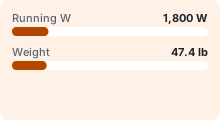
Honda EU2200i
Best for: A fridge, lights and phones, or one half of a quiet parallel pair.
- Running W (gas)1,800 W
- Voltage120V
- Noise48-57 dB(A)
- Dry weight47.4 lb
- Run time at 1/4 load8.1 h (0.95 gal)
Backup Power
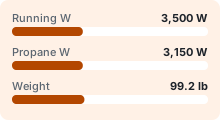
Champion 201319
Best for: 120V essentials (fridge, sump, furnace fan, lights) on gas or propane.
- Running W (gas)3,500 W
- Running W (propane)3,150 W
- Voltage120V (TT-30R RV outlet)
- Dry weight99.2 lb
- Noise61 dBA at 23 ft
Backup Power
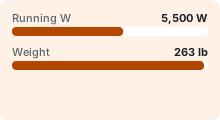
Honda EU7000iS
Best for: Buyers who put low noise and build quality first and can store stabilized gasoline.
- Running W (gas)5,500 W
- Voltage120/240V
- Noise52-58 dB(A)
- Dry weight263.2 lb
- Run time at 1/4 load16 h (5.1 gal)
California (CARB) version: EU7000iSNAC1 (the Amazon link is this version)
Backup Power
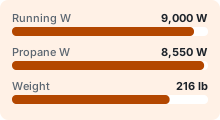
DuroMax XP11000iH
Best for: All-round 240V home backup on gas or propane, with the smallest propane drop on our list.
- Running W (gas)9,000 W
- Running W (propane)8,550 W
- Voltage120/240V
- Dry weight216 lb
- Run time at 25%18 h (7.1 gal)
Backup Power
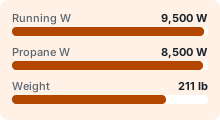
Westinghouse WGen9500DF
Best for: Whole-house-leaning 120/240V backup on a budget, where open-frame noise is acceptable.
- Running W (gas)9,500 W
- Running W (propane)8,500 W
- Starting W (gas)12,500 W
- Voltage120/240V
- Dry weight211 lb
Safety and connecting to your house
Carbon monoxide kills. The U.S. Consumer Product Safety Commission says to never run a portable generator inside a home, garage, basement, crawlspace, or shed. Keep it outside, far from windows, doors, and vents, and keep a working CO alarm in the house.[12]
Never backfeed. Champion's manual warns that a generator connected to a building must be isolated from utility power so it cannot backfeed the lines, and that the connection must meet code. Have a licensed electrician install a transfer switch or interlock.[7]
Frequently asked questions
How many watts does it take to run a house during a power outage?
For essentials only (fridge, gas-furnace fan, sump pump, lights, internet, TV), our worked example comes to about 3,000 running watts and 4,500–5,350 starting watts using cautious chart figures. Adding 240V loads like central AC or an electric water heater pushes it to 8,000 W or more.
Is a 5,000-watt generator enough for a house?
Often, for essentials, as long as its running rating (not just its peak) is around 5,000 W and you start large motors one at a time. It will not run central AC plus an electric water heater, and if it is 120V only it cannot run any 240V load.
What is the difference between starting watts and running watts?
Running watts keep a device going; starting watts are the short surge a motor or compressor needs to start. Champion estimates starting watts at 1–2× running, and warns they can exceed 3×.[4][5]
Should I size to my 200-amp panel?
No. A 200-amp, 240V panel is 48,000 W of capacity, far more than any portable generator and far more than a house uses during an outage. Size to the loads you will run.
Do I need extra watts if I run on propane?
Yes. On most dual-fuel models, propane running output is 5–10% below gasoline. Shop on the propane running figure.
Can I plug my generator into a wall outlet to power the house?
No. That backfeeds the wiring and can electrocute utility workers or start a fire. Use extension cords rated for the load, or have an electrician install a transfer switch or interlock.
Why does this calculator give higher numbers than some others?
It defaults to the higher of two manufacturers' published figures for each item and adds 20% headroom. Lower the defaults to match your nameplates, or set headroom to 0%, to see the bare minimum.
Sources
- Honda Power Equipment, "What wattage generator do I need?" powerequipment.honda.com/generators/generator-wattage-estimation-guide
- Honda Power Equipment, "What size generator do I need?" powerequipment.honda.com/generators/generator-how-much-power
- Champion Power Equipment, "Generator Wattage Chart: Common Appliances & Tools." championpowerequipment.com/generator-wattage-chart/
- Champion Power Equipment, "Choosing a Generator" wattage flyer (PDF). championpowerequipment.com/…/Generators-WattageChartFlyer-web.pdf
- Champion Power Equipment, model 40046 operator's manual (PDF), wattage reference section. championpowerequipment.com/…/40046-om-english.pdf
- Champion Help Center, "What is the difference between running watts and starting watts?" help.championpowerequipment.com
- Champion Power Equipment, model 200960 2000W Dual Fuel Inverter operator's manual (PDF): Volts × Amps = Watts; backfeed warning; 1,700 W gas / 1,530 W LPG running. championpowerequipment.com/…/200960-om-english.pdf
- Honda Power Equipment, EU2200i product page and specifications, powerequipment.honda.com/generators/models/eu2200i, and EU2200i owner's manual (PDF), cdn.powerequipment.honda.com/…/00X31Z446010.pdf
- Champion Power Equipment, 201319 4500W Electric Start Dual Fuel Inverter. championpowerequipment.com/product/201319-…
- Honda Power Equipment, EU7000iS product page and specifications. powerequipment.honda.com/generators/models/eu7000is
- Westinghouse Outdoor Power, WGen9500DF Dual Fuel specifications. westinghouse.com/products/wgen9500df-generator-dual-fuel
- U.S. Consumer Product Safety Commission, "Generators and Engine-Driven Tools." cpsc.gov
- DuroMax Power Equipment, XP11000iH specifications. duromaxpower.com/products/duromax-xp11000ih-…