
Best Inverter Generators for Home Backup: Spec-by-Spec Comparison
Quick answer: which one fits which house
- Best all-round 240V backup: DuroMax XP11000iH, 9,000 running watts on gasoline and 8,550 on propane, the smallest propane drop here.[2] Bob Vila named it best overall among the inverters it tested.[7]
- Quietest 240V option with the strongest review record: Honda EU7000iS, 5,500 running watts. It is gasoline only and the heaviest here at 263 lb.[1][8]
- Have a natural-gas line: Champion 201176 tri-fuel (gas, propane, or natural gas, 120/240V).[4]
- 120V essentials only (fridge, sump, furnace fan, lights): Champion 201319 dual-fuel, 3,500 W gas / 3,150 W propane.[5]
- Just the fridge and phones, or a second unit to pair: Honda EU2200i, 1,800 W.[6]
- Lightest 9,000 W unit: Westinghouse iGen12000DFc, 189 lb, 9,000 W gas / 8,100 W propane.[3] No independent review yet.
Not sure of your wattage? Run the generator wattage calculator first. Unsure about fuel? See inverter vs. dual fuel. Open to an open-frame unit? See our dual-fuel generator comparison.
How we chose and compared
- Scope: inverter generators sold for home backup in the U.S., from a 1,800 W suitcase unit up to 9,000 W 120/240V units. We favored models with published spec sheets and at least one independent published review.
- Specs come from each manufacturer's own product page.
- Review findings are summarized in our own words from named publications (Popular Mechanics, Bob Vila, Consumer Reports), with links. We don't reproduce their scores, and we don't use retailer star ratings or customer review quotes.
Spec table: all six side by side
| Spec | Westinghouse iGen12000DFc[3] | DuroMax XP11000iH[2] | Champion 201176[4] | Honda EU7000iS[1] | Champion 201319[5] | Honda EU2200i[6] |
|---|---|---|---|---|---|---|
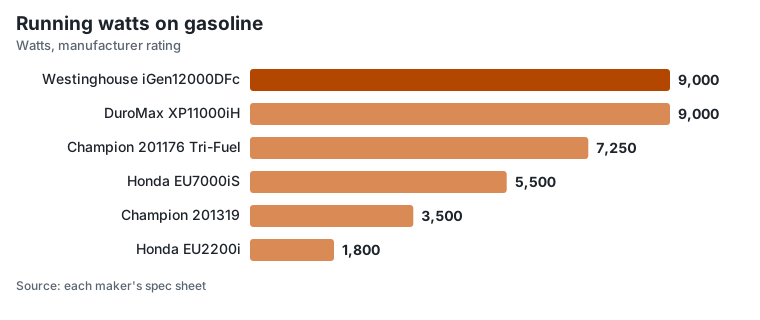
| Running W, gasoline | 9,000 | 9,000 | 7,250 | 5,500 | 3,500 | 1,800 |
| Starting/peak W, gasoline | 12,000 | 11,000 | 9,000 | 7,000 | 4,500 | 2,200 |
| Running W, propane | 8,100 | 8,550 | 6,525 | — (gas only) | 3,150 | — (gas only) |
| Running W, natural gas | — | — | 5,875 | — | — | — |
| Voltage | 120/240V | 120/240V | 120/240V | 120/240V | 120V | 120V |
| Transfer-switch outlets | L14-30R, 14-50R | 120/240V 30A and 50A | L14-30R, 14-50R | 30A 125/250V locking | No 240V outlet; TT-30R works with some 120V transfer switches via adapter | None |
| THD (published) | ≤3% | <3% | No number ("Clean Power") | No number | <3% | No number |
| Noise (as published) | "As low as 64 dBA" | 61 dB at 25% load | 72 dBA from 23 ft | 52–58 dB(A) (1/4 to rated load) | 61 dBA from 23 ft | 48–57 dB(A) (1/4 to rated load) |
| Gas tank / run time at 25% | 7.9 gal / 19 h | 7.1 gal / 18 h | 4.32 gal / 14 h | 5.1 gal / 16 h | 2.25 gal / 14 h | 0.95 gal / 8.1 h |
| Propane run time (as published) | 9 h at 25% (20-lb tank) | 16 h at 25% (40-lb tank); maker suggests 40-lb minimum | 12 h at 1/4 load | — | 21 h at 1/4 load (20-lb tank) | — |
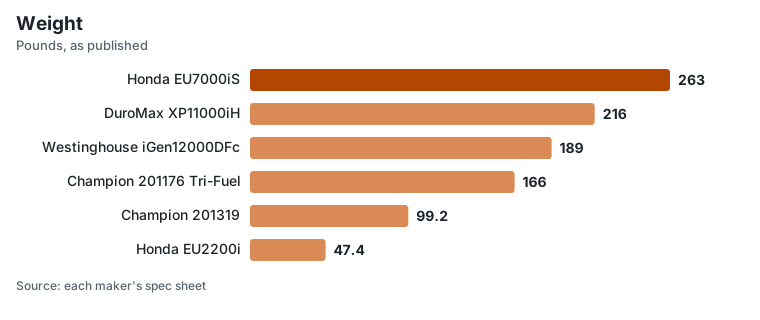
| Dry weight | 189 lb | 216 lb (Bob Vila lists 226 lb) | 165.8 lb | 263.2 lb | 99.2 lb | 47.4 lb |
| CO shutoff/sensor | Yes (CO sensor) | Yes (CO Alert) | Yes (CO Shield) | Yes (CO-MINDER) | Yes (CO Shield) | Yes (CO-MINDER) |
| Frame | Enclosed | Enclosed | Open frame | Enclosed | Enclosed | Enclosed |
| CARB (California) | No | Not stated by maker | Not stated by maker | 50-state version: EU7000iSNAC | Not stated by maker | Not for sale in CA |
What the specs reveal (our analysis)
Weight: the 9,000 W inverters are lighter than the Honda
The 9,000 W DuroMax and Westinghouse make about 1.6× the Honda EU7000iS's power at 47–74 lb less (216 and 189 lb vs 263.2 lb).[1][2][3] Any of these big units needs a level path to its outdoor spot: Popular Mechanics' reviewer needed three people to get the 263-lb Honda down a truck ramp, though it rolled easily on flat ground.[8]
Propane penalty: 5% to 10%, and natural gas costs about 19%
- DuroMax XP11000iH: 8,550 vs 9,000 W on gasoline (−5%).[2]
- Westinghouse iGen12000DFc: 8,100 vs 9,000 W (−10%).[3]
- Champion 201176: propane 6,525 vs 7,250 W (−10%); natural gas 5,875 W (−19%).[4]
- Champion 201319: 3,150 vs 3,500 W (−10%).[5]
If propane will be your main fuel, the DuroMax keeps the most of its rating. The trade-off is that DuroMax recommends at least a 40-lb cylinder,[2] while Westinghouse publishes run times on a standard 20-lb grill tank (9 hours at 25% load).[3]
240V is the dividing line
Consumer Reports makes the same split: its "large" inverter category (5,000 W and up, 240V-capable) can connect to a panel through a transfer switch or interlock to run hardwired loads such as a well pump or water heater. Mid-size 120V inverters cannot.[9] Four of our six models are 120/240V; the Champion 201319 and Honda EU2200i are 120V only.
Model-by-model: specs plus what reviewers found
1. DuroMax XP11000iH: best all-round 240V backup (dual fuel)
Specs: 9,000 / 11,000 W gasoline, 8,550 / 10,450 W propane, 120/240V 30A and 50A outlets, <3% THD, 61 dB at 25% load, 7.1-gal tank (18 h at 25%), 216 lb dry, CO Alert, 5-year warranty.[2]
What reviewers found: Bob Vila's team named it best overall among the 11 inverters it tested (published Jan 21, 2026). They reported it handled large appliances and several power tools while giving stable power to electronics, and that at light load it was quiet enough to talk over normally. They praised the easy switch to propane. Their downside was size: they did not consider it portable in the usual sense (Bob Vila lists it at 226 lb; DuroMax gives 216 lb dry).[7]
Fits: 240V homes that want the most running watts on either fuel. On propane, plan for a 40-lb or larger cylinder.
Backup Power
DuroMax XP11000iH
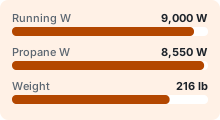
Best for: All-round 240V home backup on gas or propane, with the smallest propane drop on our list.
- Running W (gas)9,000 W
- Running W (propane)8,550 W
- Voltage120/240V
- Dry weight216 lb
- Run time at 25%18 h (7.1 gal)
2. Honda EU7000iS: quietest 240V option with the most review evidence (gas only)
Specs: 5,500 rated / 7,000 max W, 120/240V, fuel injection, 5.1-gal tank (6.4 h at rated load, 16 h at 1/4), 52–58 dB(A), 263.2 lb, CO-MINDER, parallel-capable with a kit, Bluetooth app.[1]
What reviewers found: Popular Mechanics' reviewer (Aug 17, 2026) was most impressed by how quiet it was. They measured about 70 dB with a phone app from roughly 15 feet at around 60% load, and it ran a 10-inch table saw without trouble even in Eco Throttle mode. They also liked the build quality, wheels, and app. Their main criticism was gasoline-only operation; the review notes Honda makes no dual- or tri-fuel model.[8]
Fits: buyers who put noise and build quality first and can store stabilized gasoline. Its 5,500 W rating is lower than the 9,000 W-class units.
Backup Power
Honda EU7000iS
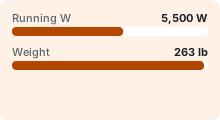
Best for: Buyers who put low noise and build quality first and can store stabilized gasoline.
- Running W (gas)5,500 W
- Voltage120/240V
- Noise52-58 dB(A)
- Dry weight263.2 lb
- Run time at 1/4 load16 h (5.1 gal)
California (CARB) version: EU7000iSNAC1 (the Amazon link is this version)
3. Champion 201176 tri-fuel: for homes with a natural-gas line
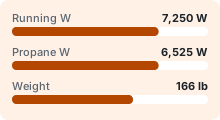
Specs: 9,000 W starting on all fuels; 7,250 / 6,525 / 5,875 running W on gasoline / propane / natural gas; 120/240V with L14-30R and 14-50R; open-frame inverter; 72 dBA from 23 ft; 4.32-gal tank (14 h at 1/4 load); 165.8 lb; CO Shield; not parallel-capable.[4]
What reviewers found: Bob Vila picked it as best tri-fuel. Its testers valued the fuel flexibility for long outages and found it quieter than conventional generators but not as quiet as the enclosed inverters they tried. They suggested semi-permanent placement because of its weight, and having a plumber connect any natural-gas line.[7]
Fits: homes with natural gas that want an effectively unlimited fuel supply and accept a lower NG rating and more noise.
Backup Power
Champion 201176 Tri-Fuel
Best for: Homes with a natural-gas line that want a 120/240V inverter on gas, propane or NG.
- Running W (gas)7,250 W
- Running W (propane / NG)6,525 / 5,875 W
- Voltage120/240V
- Dry weight165.8 lb
- Noise72 dBA at 23 ft
4. Champion 201319: 120V essentials on gas or propane
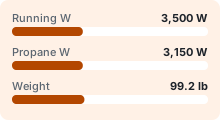
Specs: 3,500 / 4,500 W gasoline, 3,150 / 4,500 W propane, 120V only (duplex plus TT-30R), <3% THD, 61 dBA from 23 ft, 99.2 lb, CO Shield, parallel-capable.[5]
What reviewers found: Popular Mechanics lists it as best for RV camping. It credits the fuel flexibility and the 30-amp RV outlet and says it can cover some home backup, such as a few 120V circuits through a manual transfer switch. Its listed downside is that you need an adapter to use it with a transfer switch.[10]
Fits: the essentials list in our worked example (about 3,000 running watts), with little headroom on propane.
Backup Power
Champion 201319
Best for: 120V essentials (fridge, sump, furnace fan, lights) on gas or propane.
- Running W (gas)3,500 W
- Running W (propane)3,150 W
- Voltage120V (TT-30R RV outlet)
- Dry weight99.2 lb
- Noise61 dBA at 23 ft
5. Honda EU2200i: fridge-and-phones backup, or half of a parallel pair
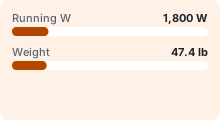
Specs: 1,800 rated / 2,200 max W, 120V, 0.95-gal tank (3.2–8.1 h), 48–57 dB(A), 47.4 lb, CO-MINDER; parallels with a second unit.[6]
What reviewers found: Popular Mechanics named it best overall in its 2026 portable-generator roundup, where every pick was an inverter. On an oscilloscope its sine wave stayed smooth even under heavy loads like a table saw or air conditioner, and the reviewers praised its quiet, enclosed design.[10] Bob Vila's testers ran a refrigerator alone on it for a few hours without problems. They noted it has no USB ports and no wheels.[7]
Fits: a refrigerator, lights, and electronics, but not a furnace fan plus a sump pump at the same time.
Backup Power
Honda EU2200i
Best for: A fridge, lights and phones, or one half of a quiet parallel pair.
- Running W (gas)1,800 W
- Voltage120V
- Noise48-57 dB(A)
- Dry weight47.4 lb
- Run time at 1/4 load8.1 h (0.95 gal)
6. Westinghouse iGen12000DFc: most watts per pound, but no independent review yet (240V, dual fuel)
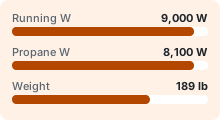
Specs: 9,000 running / 12,000 peak watts on gasoline, 8,100 / 11,000 on propane, 120/240V with L14-30R and 14-50R outlets, ≤3% THD, CO sensor, remote and electric start, 7.9-gal tank (19 h at 25%), 189 lb.[3]
Published reviews: no independent review yet.
Fits: 240V households that want the lightest 9,000 W unit here and the longest published gasoline run time (19 h at 25%).
Backup Power
Westinghouse iGen12000DFc
Best for: 240V homes that want the lightest 9,000 W inverter here, on gas or propane.
- Running W (gas)9,000 W
- Running W (propane)8,100 W
- Voltage120/240V
- Dry weight189 lb
- Run time at 25%19 h (7.9 gal)
Buying guide for a home-backup inverter
- Size it first. Use the wattage calculator and compare against the running watts on the fuel you'll use.
- Decide on 240V. If you have a well pump or want a transfer switch, only the 120/240V models qualify.
- Pick the fuel plan: gasoline only (Honda), gas plus propane (Westinghouse, DuroMax, Champion 201319), or natural gas as well (Champion 201176). Check the cylinder size the maker assumes.
- Check moving and storage. 165–263 lb units need a level path from where they're stored to a spot at least 20 feet from the house, the distance Consumer Reports advises.[9]
- Confirm CO protection. All six list a CO shutoff or sensor. Consumer Reports calls this feature very important and now tests it.[9]
- Plan the connection. Have a licensed electrician install a transfer switch or interlock. Never backfeed through an outlet.
- California: buy a CARB-compliant version where required.
Frequently asked questions
What is the best inverter generator for home backup?
For most 240V homes, the DuroMax XP11000iH: 9,000 running watts on gasoline, 8,550 on propane, and Bob Vila's best overall. The Honda EU7000iS is the quiet, gas-only option with the strongest review record. For 120V essentials, the Champion 201319 is enough for many houses.
Can an inverter generator run a whole house?
A 9,000 W inverter connected through a transfer switch can run a lot of a house, but not central AC, an electric water heater, and an electric dryer all at once. Run your list through the calculator.
Which inverter generator is best on propane?
The DuroMax XP11000iH loses the least output on propane: 8,550 vs 9,000 W, a 5% drop. The other dual-fuel models here lose about 10%.
Do I need a 240V inverter generator?
Yes, if you want to power a well pump or other 240V hardwired loads, or connect to your panel through a typical transfer switch. 120V-only models can't do either.
Are open-frame inverters like the Champion 201176 louder?
Champion lists 72 dBA from 23 feet for the 201176, versus 61 dBA for its enclosed 201319. Bob Vila's testers likewise found it quieter than conventional generators but louder than enclosed inverters.
Sources
- Honda Power Equipment, EU7000iS product page and specifications. powerequipment.honda.com/generators/models/eu7000is
- DuroMax Power Equipment, XP11000iH product page and specifications. duromaxpower.com/products/duromax-xp11000ih-…
- Westinghouse Outdoor Power, iGen12000DFc specifications. westinghouse.com/products/igen12000dfc-…
- Champion Power Equipment, 201176 9000W Electric Start Tri Fuel Open Frame Inverter. championpowerequipment.com/product/201176-…
- Champion Power Equipment, 201319 4500W Electric Start Dual Fuel Inverter. championpowerequipment.com/product/201319-…
- Honda Power Equipment, EU2200i product page and specifications. powerequipment.honda.com/generators/models/eu2200i
- Glenda Taylor, Tom Scalisi, Mark Wolfe, "The Best Inverter Generators of 2026," Bob Vila, published Jan 21, 2026. bobvila.com/reviews/best-inverter-generators-2026/
- David Dritsas, Honda EU7000iS review, Popular Mechanics, published Aug 17, 2026. popularmechanics.com/home/a73437788/…
- Allen St. John, "Best Inverter Generators of 2026, Lab-Tested and Reviewed," Consumer Reports, updated Jan 1, 2026 (public portion; model ratings are members-only). consumerreports.org/…/best-and-worst-inverter-generators-a9189700579/
- "The 6 Best Portable Generators for 2026, Tested and Reviewed," Popular Mechanics. popularmechanics.com/home/tools/a39528638/best-portable-generators/