
Best Dual-Fuel Generators for Home Backup: Open-Frame vs Inverter, Spec by Spec
Quick answer: which one fits which house
- Best overall: DuroMax XP11000iH dual-fuel inverter, 9,000 running watts on gasoline and 8,550 on propane, with a CO shutoff and both 30A and 50A 240V outlets.[1] Popular Mechanics and Bob Vila each named it best overall after testing it in 2026.[8][12]
- Best open-frame (and the natural-gas option): Generac GP9500E Tri Fuel, 9,500 / 8,550 / 7,000 running watts on gasoline / propane / natural gas, with COsense shutoff and a 50A outlet.[2]
- Most 240V appliance evidence, no CO shutoff: Westinghouse WGen9500DF, 9,500 / 8,500 W, electric and remote start.[4]
- Mid-size, lighter 240V unit for a 30A transfer switch: Westinghouse WGen5300DFcv, 5,300 / 4,800 W, 135.6 lb, CO sensor.[5][6]
- 120V essentials only: Champion 201319 dual-fuel inverter, 3,500 / 3,150 W, 99.2 lb.[7]
Not sure of your wattage? Run the generator wattage calculator first, then compare against the propane rating if propane is your main fuel.
How we chose and compared
- Scope: portable generators that run on gasoline and propane (two also run on natural gas) sold for home backup in the U.S., currently listed by their makers.
- Ranking rule: a model has to have at least one published review from a named outlet that ran it. Specs and our arithmetic decide the order among those.
- Specs come from each manufacturer's product page, spec sheet or owner's manual.
- Review findings are summarized in our own words from Popular Mechanics and Bob Vila, with links and dates. We don't reproduce their scores, and we don't use retailer star ratings or customer review quotes.
Spec table: all five side by side
| Spec | DuroMax XP11000iH[1] | Generac GP9500E[3] | Westinghouse WGen9500DF[4] | Westinghouse WGen5300DFcv[5] | Champion 201319[7] |
|---|---|---|---|---|---|
| Type | Inverter, enclosed | Open frame | Open frame | Open frame | Inverter, enclosed |
| Running W, gasoline | 9,000 | 9,500 | 9,500 | 5,300 | 3,500 |
| Starting/peak W, gasoline | 11,000 | 12,500 | 12,500 | 6,500 | 4,500 |
| Running W, propane | 8,550 | 8,550 | 8,500 | 4,800 | 3,150 |
| Propane drop (our arithmetic) | −5% | −10% | −10.5% | −9.4% | −10% |
| Running W, natural gas | — | 7,000 | — | — | — |
| Voltage | 120/240V | 120/240V | 120/240V | 120/240V | 120V |
| Transfer-switch outlets | 120/240V 30A and 50A | L14-30R and 14-50R | L14-30R and 14-50R | L14-30R (plus TT-30R) | TT-30R only (120V) |
| CO shutoff | Yes (CO Alert) | Yes (COsense) | No | Yes (CO Sensor)[6] | Yes (CO Shield) |
| Gas tank / run time at 25% | 7.1 gal / 18 h | 7.5 gal / 14 h | 6.6 gal / 12 h | 4.7 gal / 14.5 h | 2.25 gal / 14 h |
| Propane run time (as published) | 16 h at 25% (40-lb tank) | 6 h at 25%, 4.5 h at 50% (20-lb tank) | 7 h at 50% | 9 h at 50% | 21 h at 1/4 load (20-lb tank) |
| Noise (maker figure) | 61 dB at 25% load | Not published on the spec sheet | 74 dBA | 68 dBA | 61 dBA from 23 ft |
| Weight | 216 lb dry | 219 lb | 211 lb | 135.6 lb dry | 99.2 lb |
| Start | Electric, remote, recoil | Electric, recoil | Electric, remote, recoil | Recoil | Electric, recoil |
| California (CARB) | Not stated by maker | Specs are the 49-state 8063-0; a 50-state EFI version (8061) is sold | No | No | Not stated by maker |
What the specs reveal (our analysis)
1. Your transfer-switch inlet can cap a 9,500 W generator
A 30A 240V outlet (L14-30R) can deliver at most 30 A × 240 V = 7,200 W. A 50A outlet (14-50R) can deliver 12,000 W. The Generac's rated 240V current on gasoline is 39.6 A,[3] more than a 30A circuit carries, so through a 30A inlet you can use only about three-quarters of its 9,500 running watts. The same arithmetic applies to the WGen9500DF and DuroMax XP11000iH. If you're buying a 9,000 W-class unit to run essentials plus central AC or a well pump, ask the electrician for a 50A inlet and transfer switch. The WGen5300DFcv's 5,300 W fits within a 30A inlet with room to spare.
2. Propane costs 5% to 10% of your watts; natural gas costs about 26%
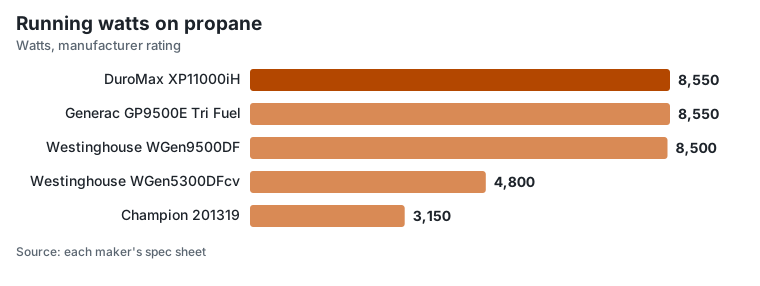
- DuroMax XP11000iH: 8,550 vs 9,000 W (−5%), the smallest drop here.[1]
- Generac GP9500E: 8,550 vs 9,500 W on propane (−10%) and 7,000 W on natural gas (−26%).[3]
- Westinghouse WGen9500DF: 8,500 vs 9,500 W (−10.5%).[4]
- Westinghouse WGen5300DFcv: 4,800 vs 5,300 W (−9.4%).[5]
- Champion 201319: 3,150 vs 3,500 W (−10%).[7]
Popular Mechanics gives the same rule of thumb, about 10% less output on propane, and suggests buying 20–25% more generator than you think you need.[14] If you plan to run on propane most of the time, compare your calculator total against the propane column, not the gasoline one.
3. How many 20-lb propane cylinders a day
Generac publishes 4.5 hours at half load on a 20-lb cylinder.[3] A full day at half load is 24 ÷ 4.5 ≈ 5.3 cylinders, so a grill tank or two only bridges an evening. For multi-day outages on propane, plan for 40-lb or larger cylinders (DuroMax recommends at least 40 lb for the XP11000iH[1]), or use the Generac's natural-gas connection if you have a gas line.
4. Which calculator load each model fits
These are the loads from our wattage calculator guide, matched to each model's running watts on the fuel you'd use:
| Load | Running W needed | Fits |
|---|---|---|
| Essentials (fridge, furnace fan, sump, lights, TV, modem, chargers) | About 3,000, start-up surge about 4,500 | All five; the Champion 201319 has little headroom on propane |
| Fridge, furnace fan, lights and a 1 hp well pump (240V) | About 5,500, on 240V | The 9,000 W class; the WGen5300DFcv (5,300 W) is just under, and the 120V Champion can't run a 240V pump |
| Full essentials plus a well pump | About 6,000 | The 9,000 W class: XP11000iH, GP9500E, WGen9500DF |
| Essentials plus central AC or an electric water heater | 9,000 W class | XP11000iH, GP9500E, WGen9500DF, ideally on a 50A inlet |
| More than one big 240V load at once | Beyond a portable | A standby generator |
5. Weight: the 9,000 W class is all 211–219 lb
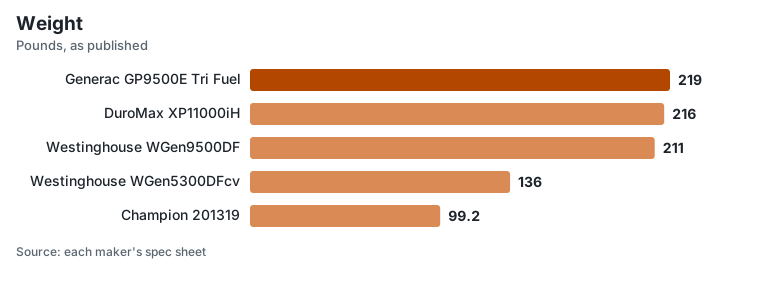
The open-frame and inverter 9,000 W units weigh within 8 lb of each other (211, 216 and 219 lb), so the inverter's quieter enclosure doesn't come with a weight penalty. Stepping down to the WGen5300DFcv saves about 75 lb; the Champion 201319 is the only one most people can lift.
Ranked picks: specs plus what reviewers found
1. DuroMax XP11000iH: best overall dual-fuel generator for home backup
Specs: 9,000 / 11,000 W gasoline, 8,550 / 10,450 W propane, 120/240V 30A and 50A outlets, <3% THD, 61 dB at 25% load, 7.1-gal tank (18 h at 25%), 216 lb dry, CO Alert, 5-year warranty.[1]
What reviewers found: Popular Mechanics' reviewer (updated Aug 27, 2026) wrote that of the many gas generators they had tried, it may be the quietest one able to back up a whole home, and quieter still on propane. They liked the remote start, battery tender and onboard display, and their only complaint was the weight.[8] Bob Vila's team also named it best overall among the inverters it tested (Jan 21, 2026), reporting that it ran large appliances and power tools while giving stable power to electronics.[12]
Why it's our top pick: it is the only model here with two 2026 best-overall picks from outlets that ran it, it loses the least on propane (5%), it has both a CO shutoff and a 50A outlet, and its 9,000 W rating covers every 9,000 W-class load in the calculator.
Watch for: DuroMax suggests a 40-lb or larger propane cylinder, and at 216 lb it needs a level path to its outdoor spot.
Backup Power
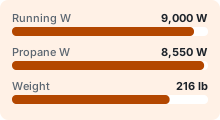
DuroMax XP11000iH
Best for: All-round 240V home backup on gas or propane, with the smallest propane drop on our list.
- Running W (gas)9,000 W
- Running W (propane)8,550 W
- Voltage120/240V
- Dry weight216 lb
- Run time at 25%18 h (7.1 gal)
2. Generac GP9500E Tri Fuel: best open-frame pick, and the one that runs on natural gas
Specs: 9,500 / 12,500 W gasoline, 8,550 / 11,250 W propane, 7,000 / 9,000 W natural gas; 120/240V with L14-30R and 14-50R; 500cc engine; 7.5-gal tank (14 h at 25%, 9.5 h at 50%); COsense CO shutoff and low-oil shutdown; electric start with battery included; hour meter; HomeLink transfer-switch compatible; 219 lb; 3-year residential warranty.[3]
What reviewers found: Popular Mechanics named it best value and ran it on natural gas during a storm outage when it had no gasoline or propane on hand. The reviewer found it a moderate purr on lights and a few appliances and closer to a roar when the heat came on. They described it as basic but sturdy, with tougher outlet covers than many rivals, and very heavy. The review notes this model was not part of Generac's carburetor recall.[8]
Fits: houses with a natural-gas line, or anyone who wants open-frame 240V output with a CO shutoff. Use the 14-50R to get its full output.
Backup Power
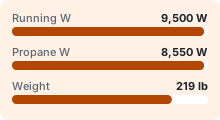
Generac GP9500E Tri Fuel
Best for: Open-frame 240V backup with CO shutoff and a natural-gas option.
- Running W (gas)9,500 W
- Running W (propane)8,550 W
- Running W (natural gas)7,000 W
- Unit weight219 lb
- Run time at 25%14 h (7.5 gal)
California (CARB) version: GP9500E with EFI (Generac 8061) (the Amazon link is this version)
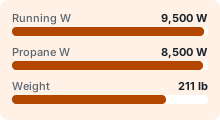
3. Westinghouse WGen9500DF: proven on 240V appliances, but no CO shutoff
Specs: 9,500 / 12,500 W gasoline, 8,500 / 11,200 W propane, 120/240V with L14-30R and 14-50R, electric, remote and recoil start, 6.6-gal tank (12 h at 25%), 74 dBA, 211 lb. Westinghouse lists no CO sensor for this model.[4]
What reviewers found: Bob Vila named it best overall in its dual-fuel roundup (last updated Oct 8, 2024), describing it as strong enough for several tools at once, plus an oven/range combo and a clothes dryer separately. Its listed downsides were the 211-lb weight and a reading of 89 dB from 6 feet.[10] In a separate Bob Vila review (Oct 24, 2023), the reviewer powered lights, power tools, a 30-amp dryer and a 50-amp oven/range combo from it, not all at the same time, and called out the weight and noise.[11] Popular Mechanics lists Westinghouse's 12,500-watt dual-fuel generator as best for high-voltage appliances.[8]
Why it's not higher: it has no CO shutoff, its review evidence is older than the picks above, and Westinghouse's own store shows it out of stock.
Backup Power
Westinghouse WGen9500DF
Best for: Whole-house-leaning 120/240V backup on a budget, where open-frame noise is acceptable.
- Running W (gas)9,500 W
- Running W (propane)8,500 W
- Starting W (gas)12,500 W
- Voltage120/240V
- Dry weight211 lb
4. Westinghouse WGen5300DFcv: mid-size 240V for a 30A transfer switch
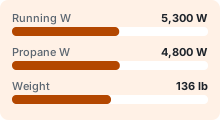
Specs: 5,300 / 6,500 W gasoline, 4,800 / 5,800 W propane, 120/240V with L14-30R and TT-30R plus a 5-20R duplex, 274cc engine, 4.7-gal tank (14.5 h at 25%), 68 dBA, recoil start, 135.6 lb dry.[5] The owner's manual describes a CO Sensor that shuts the engine down when carbon monoxide builds up.[6]
What reviewers found: Bob Vila named it best dual fuel in its 2026 portable-generator roundup (Jul 29, 2026). Set-up took about 20 minutes, and it started on the first pull on gasoline and in three pulls on propane. They measured about 88.5 dB from 5 feet, well above the maker's 68 dBA, and noted it may be too loud for some campgrounds.[9]
Fits: the essentials list (about 3,000 running watts) with plenty of headroom on either fuel, through an ordinary 30A transfer switch. It sits just under the roughly 5,500 running watts our sizing guide gives for adding a 1 hp well pump, and it's too small for central AC on top of essentials.
Backup Power
Westinghouse WGen5300DFcv
Best for: Mid-size 240V backup through a 30A transfer switch, with a CO sensor.
- Running W (gas)5,300 W
- Running W (propane)4,800 W
- OutletsL14-30R, TT-30R, 5-20R
- Dry weight135.6 lb
- Run time at 25%14.5 h (4.7 gal)
5. Champion 201319: 120V essentials on gas or propane
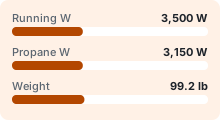
Specs: 3,500 / 4,500 W gasoline, 3,150 / 4,500 W propane, 120V only (duplex plus TT-30R), <3% THD, 61 dBA from 23 ft, 99.2 lb, CO Shield, parallel-capable.[7]
What reviewers found: Popular Mechanics lists it as best for RV camping and says it can cover some home backup, such as a few 120V circuits through a manual transfer switch, with an adapter.[13]
Fits: the essentials list in our worked example (about 3,000 running watts). No 240V, so no well pump.
Backup Power
Champion 201319
Best for: 120V essentials (fridge, sump, furnace fan, lights) on gas or propane.
- Running W (gas)3,500 W
- Running W (propane)3,150 W
- Voltage120V (TT-30R RV outlet)
- Dry weight99.2 lb
- Noise61 dBA at 23 ft
Buying checklist
- Size it on the fuel you'll use. Run the wattage calculator and compare against the propane rating if propane is the plan.
- Match the outlet to the inlet. 9,000 W-class units need a 50A inlet to deliver everything; a 30A inlet tops out at 7,200 W.
- Insist on a CO shutoff. Four of the five have one; the WGen9500DF does not. Run any generator at least 20 feet from the house, the distance Consumer Reports advises.[15]
- Plan propane supply. At half load a 20-lb cylinder lasts hours, not a day. Bigger cylinders or natural gas cover long outages.
- Open frame or inverter? Open-frame units are louder, and Westinghouse lists ≤23% distortion for its open-frame models against <3% for the inverters here.[4][1] See inverter vs. dual fuel and our inverter comparison.
- Hire an electrician for the transfer switch or interlock. Never backfeed through an outlet.
- California: buy a CARB-compliant version where required.
Frequently asked questions
What is the best dual-fuel generator for home backup?
The DuroMax XP11000iH: 9,000 running watts on gasoline, 8,550 on propane, CO shutoff, and 30A and 50A 240V outlets. Popular Mechanics and Bob Vila both named it best overall in 2026. If you want an open-frame unit or natural gas, the Generac GP9500E is the pick.
How much power does a dual-fuel generator lose on propane?
About 5% to 10% on these five models: the DuroMax XP11000iH drops 5% and the rest about 9–10.5%. Natural gas on the Generac GP9500E costs about 26%.
Is a dual-fuel generator worth it?
For home backup, usually yes. Propane stores for years without going stale, while gasoline degrades, and a second fuel helps when stations are closed. The trade-off is about 10% less output on propane.
Dual fuel vs tri fuel: what's the difference?
A tri-fuel generator such as the Generac GP9500E also connects to a natural-gas line, which gives an effectively unlimited supply in an outage. It makes the least power on natural gas: 7,000 W vs 9,500 W on gasoline for the Generac.
Can a dual-fuel generator run a whole house?
A 9,000 W-class unit on a 50A transfer switch can run essentials plus one big 240V load, such as central AC or a well pump, at a time. More than one big 240V load at once calls for a standby generator.
Sources
- DuroMax Power Equipment, XP11000iH product page and specifications. duromaxpower.com/products/duromax-xp11000ih-…
- Generac, GP9500E Tri Fuel Portable Generator (49-state) product page. generac.com/residential-products/portable-generators/9500-tri-fuel-…
- Generac, GP9500E TF spec sheet, model 8063-0 (Rev. A, Dec 11, 2024). generac.com/…/8063-portable-spec-sheet.pdf
- Westinghouse Outdoor Power, WGen9500DF specifications. westinghouse.com/products/wgen9500df-generator-dual-fuel
- Westinghouse Outdoor Power, WGen5300DFcv specifications. westinghouse.com/products/wgen5300dfcv-dual-fuel-with-co-sensor
- Westinghouse Outdoor Power, WGen5300DFcv owner's manual, CO Sensor section. content.syndigo.com/…/original.pdf
- Champion Power Equipment, 201319 4500W Electric Start Dual Fuel Inverter. championpowerequipment.com/product/201319-…
- David Dritsas, "The 9 Best Home Generators Are a Big Investment. These Deliver Reliable Power During an Outage," Popular Mechanics, updated Aug 27, 2026. popularmechanics.com/home/a24797353/home-generator/
- Mark Wolfe, "The Best Portable Generators of 2026, Tested and Reviewed," Bob Vila, Jul 29, 2026. bobvila.com/reviews/best-portable-generator/
- Timothy Dale, "The Best Dual-Fuel Generators for Home and Outdoor Use, Tested," Bob Vila, updated Oct 8, 2024. bobvila.com/articles/best-dual-fuel-generator/
- Glenda Taylor, "Dual-Fuel Dynamo: A Westinghouse WGen9500DF Generator Review," Bob Vila, Oct 24, 2023. bobvila.com/articles/westinghouse-wgen9500df-generator-review/
- Glenda Taylor, Tom Scalisi, Mark Wolfe, "The Best Inverter Generators of 2026," Bob Vila, Jan 21, 2026. bobvila.com/reviews/best-inverter-generators-2026/
- "The 6 Best Portable Generators for 2026, Tested and Reviewed," Popular Mechanics. popularmechanics.com/home/tools/a39528638/best-portable-generators/
- Bradley Ford, "For Trouble-Free Operation, Stop Using Gasoline in Your Dual-Fuel Generator," Popular Mechanics. popularmechanics.com/home/tools/a73928408/…
- Allen St. John, "Best Inverter Generators of 2026, Lab-Tested and Reviewed," Consumer Reports, updated Jan 1, 2026 (public portion). consumerreports.org/…/best-and-worst-inverter-generators-a9189700579/