
Inverter vs. Dual-Fuel Generators for Home Backup: Which One Fits Your House?
Quick answer
"Inverter" and "dual fuel" answer two different questions, so you can have both in one machine.
- Inverter describes how the electricity is made. Electronics clean up the output, and the engine speeds up and slows down with the load. On spec sheets that shows up as low distortion (Champion lists under 3% THD for its 201319 inverter[1]), lower noise, and variable engine speed.
- Dual fuel describes what it burns: gasoline or propane. Expect 5–10% less running output on propane.[1][4][8]
For home backup, the real choice is between three kinds of machine:
- A small or mid-size inverter (1,800–5,500 running watts, gas or dual fuel), for essentials and close neighbors.
- A large dual-fuel inverter with 240V, up to about 9,000 running watts, such as the DuroMax XP11000iH or Westinghouse iGen12000DFc.[8][9] Quiet and clean power for well pumps and a transfer switch, but they weigh 189–216 lb.
- A big open-frame dual-fuel unit around 9,500 running watts with 240V, at the cost of more noise and rougher power.
Not sure how many watts you need? Start with our generator wattage calculator.
The two questions: power type and fuel type
Most comparisons treat this as a two-way fight. It is really a grid of four combinations, and all four are sold:
| Gasoline only | Dual fuel (gasoline or propane) | |
|---|---|---|
| Inverter | Quiet, clean power, light. Example: Honda EU2200i (1,800 W rated)[2]; Honda EU7000iS (5,500 W rated, 120/240V)[3] | Inverter benefits plus a propane option. Example: Champion 201319 (3,500 W gas / 3,150 W propane running)[1] |
| Conventional (open frame) | The traditional jobsite/backup generator: fixed engine speed, more watts per dollar and per pound, louder | Big output and fuel flexibility. Example: Westinghouse WGen9500DF (9,500 W gas / 8,500 W propane running)[4] |
Conventional generators run the engine at a fixed speed to hold 60 Hz. The WGen9500DF lists "60 Hz @ 3600 RPM."[4] Inverters let engine speed vary. Champion lists "Engine Speed: Variable" for the 201319[1], and Honda credits its Eco Throttle for the EU2200i's run time.[2]
Four generators side by side
We picked one model from each corner of the grid that is relevant to home backup. These are reference points, not ranked picks. All figures are from each manufacturer's own page or manual.
| Spec | Honda EU2200i[2] | Champion 201319[1] | Honda EU7000iS[3] | Westinghouse WGen9500DF[4] |
|---|---|---|---|---|
| Type | Inverter, gas | Inverter, dual fuel | Inverter, gas (fuel injected) | Open frame, dual fuel |
| Running W, gasoline | 1,800 | 3,500 | 5,500 | 9,500 |
| Starting/peak W, gasoline | 2,200 | 4,500 | 7,000 | 12,500 |
| Running W, propane | — | 3,150 | — | 8,500 |
| Voltage | 120V | 120V | 120/240V | 120/240V |
| Power quality (THD) | No figure published ("stable, clean power") | <3% | No figure published ("clean power") | ≤23% |
| Noise (as published) | 57 dB(A) rated load; 48 at 1/4 | 61 dBA "from 23 feet" | 58 dB(A) rated load; 52 at 1/4 | "As low as 74 dBA" |
| Gas tank / run time | 0.95 gal: 3.2 h rated, 8.1 h at 1/4 | 2.25 gal: 14 h at 1/4 | 5.1 gal: 6.4 h rated, 16 h at 1/4 | 6.6 gal: 12 h at 25%, 8 h at 50% |
| Propane run time (20-lb tank) | — | 21 h at 1/4 | — | 7 h at 50% |
| Dry weight | 47.4 lb | 99.2 lb | 263.2 lb | 211 lb |
| CO shutoff | Yes (CO-MINDER) | Yes (CO Shield) | Yes (CO-MINDER) | Spec sheet: "CO Sensor: No" |
| Transfer-switch outlet | No (120V duplex) | No (120V duplex + TT-30R RV) | 30A 125/250V locking | L14-30R and 14-50R |
The four generators in this comparison
Backup Power
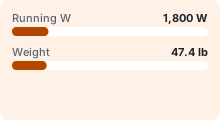
Honda EU2200i
Best for: A fridge, lights and phones, or one half of a quiet parallel pair.
- Running W (gas)1,800 W
- Voltage120V
- Noise48-57 dB(A)
- Dry weight47.4 lb
- Run time at 1/4 load8.1 h (0.95 gal)
Backup Power
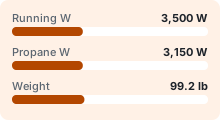
Champion 201319
Best for: 120V essentials (fridge, sump, furnace fan, lights) on gas or propane.
- Running W (gas)3,500 W
- Running W (propane)3,150 W
- Voltage120V (TT-30R RV outlet)
- Dry weight99.2 lb
- Noise61 dBA at 23 ft
Backup Power
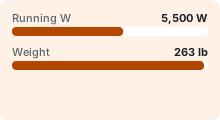
Honda EU7000iS
Best for: Buyers who put low noise and build quality first and can store stabilized gasoline.
- Running W (gas)5,500 W
- Voltage120/240V
- Noise52-58 dB(A)
- Dry weight263.2 lb
- Run time at 1/4 load16 h (5.1 gal)
California (CARB) version: EU7000iSNAC1 (the Amazon link is this version)
Backup Power
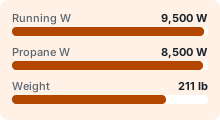
Westinghouse WGen9500DF
Best for: Whole-house-leaning 120/240V backup on a budget, where open-frame noise is acceptable.
- Running W (gas)9,500 W
- Running W (propane)8,500 W
- Starting W (gas)12,500 W
- Voltage120/240V
- Dry weight211 lb
What the numbers tell us
1. Open-frame dual-fuel units give you far more watts per pound
Divide running watts by dry weight: the WGen9500DF delivers about 45 W per pound (9,500 ÷ 211), the EU2200i about 38, the Champion 201319 about 35, and the EU7000iS about 21 W per pound (5,500 ÷ 263.2). Inverter electronics and sound-deadening enclosures add weight, so the EU7000iS is the heavy one here. Newer large inverters close the gap: the 9,000 W DuroMax XP11000iH (216 lb) and Westinghouse iGen12000DFc (189 lb) weigh about the same as the 9,500 W open-frame WGen9500DF.[8][9]
2. Inverters are much quieter
The inverters publish 48–61 dB(A); the open-frame unit publishes "as low as 74 dBA." Even allowing for different test methods, a gap of 13+ dB is large, because decibels are logarithmic. Noise matters if the generator runs all night 20+ feet from your house and your neighbor's.
3. Power quality: under 3% vs. up to 23% distortion
Total harmonic distortion (THD) measures how far the output strays from a clean sine wave. Champion markets the 201319's under-3% THD as safe for "sensitive electronics"[1], and Honda says its inverter power is "as reliable as the power you get from your outlets at home."[2] The open-frame WGen9500DF lists ≤23%.[4] If you will run computers, a gas furnace control board, or other electronics, check each device's manual and favor low-THD output.
4. Propane costs you 5–10% of running output
Every dual-fuel model we compare has a lower running rating on propane: WGen9500DF 8,500 vs 9,500 W (−10.5%)[4], Champion 201319 3,150 vs 3,500 W (−10%)[1], Westinghouse iGen12000DFc 8,100 vs 9,000 W (−10%)[9], and DuroMax XP11000iH 8,550 vs 9,000 W (−5%)[8]. That fits the fuel itself: the U.S. Energy Information Administration lists propane at 91,452 Btu per gallon against 120,214 for gasoline, about 76% as much energy per gallon.[6] If you plan to run on propane, size to the propane rating.
5. Sizing is what saves fuel
A 9,500 W open-frame generator powering a 1,000 W overnight load runs at a small share of its capacity, at a fixed engine speed. An inverter throttles its engine down to match the load. If your overnight load is small, a generator sized close to it will burn less fuel.
6. 240V is the real dividing line for home backup
Small and mid-size inverters such as the EU2200i and Champion 201319 are 120V only.[1][2] Well pumps, central AC, electric water heaters, and most whole-panel transfer switches need 120/240V. That leaves the large inverters (the 5,500 W EU7000iS, or 9,000 W dual-fuel models like the DuroMax XP11000iH) or the big open-frame units (WGen9500DF, with an L14-30R twist-lock outlet).[3][4][8]
Gasoline vs. propane for outages
| Gasoline | Propane | |
|---|---|---|
| Output | Full rated output | 5–10% lower running watts[1][4][8] |
| Energy per gallon | 120,214 Btu[6] | 91,452 Btu[6] |
| Storage | Champion's manual gives a maximum shelf life of up to 1 year with a fuel stabilizer, and warns gasoline left in the carburetor can gum it up within 2–4 weeks[5] | Stored in sealed cylinders. Champion's manual says to check the cylinder's requalification date and inspect hoses and fittings for leaks after storage[5] |
| Cold weather | Cold starting procedures apply (see manual) | Champion warns that frost on the cylinder can reduce propane vaporization and starve the engine. Fixes include swapping cylinders to let one warm up[5] |
| Run time example | WGen9500DF: 8 h at 50% on a full 6.6-gal tank[4] | WGen9500DF: 7 h at 50% on a 20-lb cylinder[4]; Champion 201319: 21 h at 1/4 load on a 20-lb cylinder vs 14 h on its 2.25-gal gas tank[1] |
Our take: dual fuel is cheap insurance for a backup generator that may sit for months. You can keep a few sealed propane cylinders ready instead of rotating stabilized gasoline, then switch to gasoline when that's what you can get. Its main costs are the 5–10% propane output penalty and cold-weather vaporization limits on small cylinders.
Which one fits your house?
Choose a gas inverter if…
- Your outage list is essentials only: up to about 3,000 running W on a mid-size unit like the Champion 201319 (3,500 W rated), or about 1,500 W on a small one like the EU2200i (1,800 W rated), keeping some headroom
- Noise matters: close neighbors, running overnight
- You'll also use it for camping or an RV
- You'll run electronics and want under-3% THD-class output
Choose a dual-fuel inverter if…
- You want inverter quietness and propane storage convenience
- Your load fits 120V and stays under the propane running rating (e.g., 3,150 W on the Champion 201319)
Choose a large dual-fuel inverter if…
- You need 240V for a well pump or a transfer switch
- Your list is up to about 9,000 running W (8,100–8,550 W on propane)
- You want inverter quietness and clean power, and can move 189–216 lb
Choose a large open-frame dual-fuel if…
- You need 240V and around 9,500 running W
- Noise and power quality matter less to you
- You can place it well away from the house and neighbors
Comparing the large 240V inverters? See our spec-by-spec comparison of six inverters for home backup.
Leaning dual fuel? Our dual-fuel generator comparison ranks five gas-and-propane models, open-frame and inverter, on propane output, CO shutoff and 50A outlets.
Buying checklist
- Run the numbers first with the wattage calculator. Use the propane running figure if you'll use propane.
- 120V or 120/240V? Any 240V appliance or a whole-panel transfer switch needs 120/240V.
- Outlets: L14-30R or 14-50R for a transfer switch inlet; TT-30R for an RV.
- THD: look for a published figure if you'll power electronics. "Clean power" without a number is a claim, not a spec.
- CO shutoff: CO-MINDER, CO Shield, and similar systems shut the engine down when CO builds up.[1][3] Don't assume every model has one; the WGen9500DF spec sheet says it does not.[4]
- Noise: check the test distance and load when it's given (Champion states 23 feet).[1]
- Weight and wheels: 200–260 lb units need a clear rolling path from storage to their outdoor spot.
- Start type: electric start matters for anyone who can't pull a recoil cord on a cold night.
- California buyers: check CARB compliance on the spec sheet.
Safety
Run any portable generator outside only, far from windows, doors, and vents, never in a garage, basement, crawlspace, or shed, and keep a working CO alarm inside.[7] Connect to house wiring only through a transfer switch or interlock installed by a licensed electrician, so the generator cannot backfeed the utility lines.[5] Store and connect propane cylinders according to the generator manual.
Frequently asked questions
Is a dual-fuel generator better than an inverter?
They are not alternatives. Inverter is about power quality and noise; dual fuel is about fuel choice. Pick the power type by noise, electronics, and 240V needs, then decide whether a propane option is worth it. Dual-fuel inverters exist.
What is a dual-fuel inverter generator?
An inverter generator that can run on gasoline or propane. For example, the Champion 201319 is rated 3,500 running watts on gasoline and 3,150 on propane, with under 3% THD.[1]
Do dual-fuel generators lose power on propane?
Yes, 5–10% less running output on the dual-fuel models we compare. Propane also carries about 76% of gasoline's energy per gallon, per EIA figures.[6]
Can an inverter generator power a whole house?
A large one can run a lot of a house. Inverters now reach about 9,000 running watts with 240V output (DuroMax XP11000iH, Westinghouse iGen12000DFc), and through a transfer switch that covers essentials plus a well pump or one big 240V load at a time.[8][9] Central AC, an electric water heater, and an electric dryer together still need load management or a standby generator. See our large-inverter comparison.
Are open-frame generators safe for electronics?
Many people use them, but output quality varies. The WGen9500DF lists up to 23% THD versus under 3% for the Champion inverter. Check the generator's and the device's manuals, and consider a quality surge protector or a small inverter for electronics.
Is propane or gasoline better for a backup generator that sits unused?
Propane avoids gasoline's storage limits. Champion's manual gives gasoline a shelf life of up to one year with stabilizer and warns about carburetor gumming within weeks. Propane has its own limits: lower output and cold-weather vaporization.[5]
Sources
- Champion Power Equipment, 201319 4500W Electric Start Dual Fuel Inverter: specifications (gas 4,500/3,500 W; propane 4,500/3,150 W; <3% THD; 61 dBA from 23 ft; 99.2 lb; variable engine speed; CO Shield). championpowerequipment.com/product/201319-…
- Honda Power Equipment, EU2200i product page and specifications. powerequipment.honda.com/generators/models/eu2200i
- Honda Power Equipment, EU7000iS product page and specifications. powerequipment.honda.com/generators/models/eu7000is
- Westinghouse Outdoor Power, WGen9500DF Dual Fuel: specifications (THD ≤23%; 60 Hz @ 3600 RPM; CO sensor: No; 211 lb). westinghouse.com/products/wgen9500df-generator-dual-fuel
- Champion Power Equipment, model 200960 2000W Dual Fuel Inverter operator's manual (PDF). championpowerequipment.com/…/200960-om-english.pdf
- U.S. Energy Information Administration, "British thermal units (Btu)," sample Btu conversion factors. eia.gov/energyexplained/units-and-calculators/british-thermal-units.php
- U.S. Consumer Product Safety Commission, "Generators and Engine-Driven Tools." cpsc.gov
- DuroMax Power Equipment, XP11000iH specifications. duromaxpower.com/products/duromax-xp11000ih-…
- Westinghouse Outdoor Power, iGen12000DFc specifications. westinghouse.com/products/igen12000dfc-…